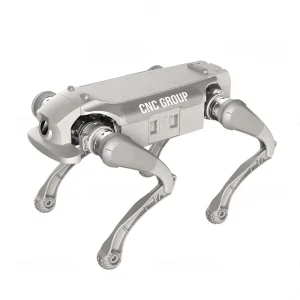
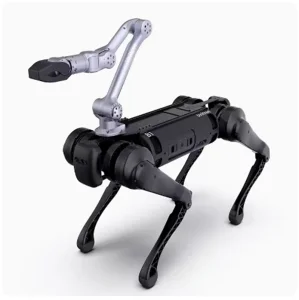
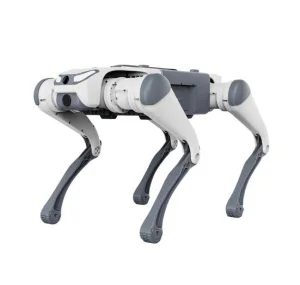
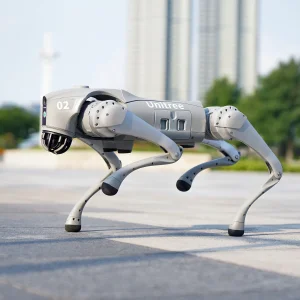
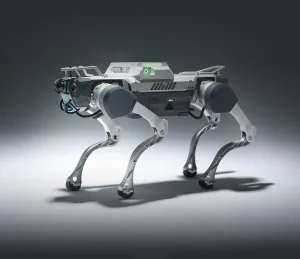
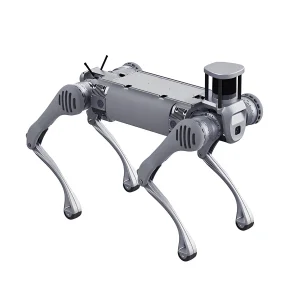
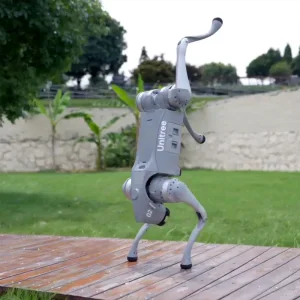
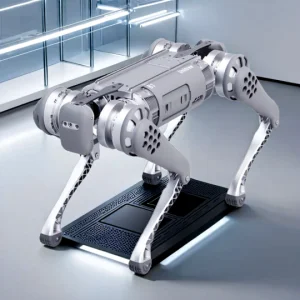
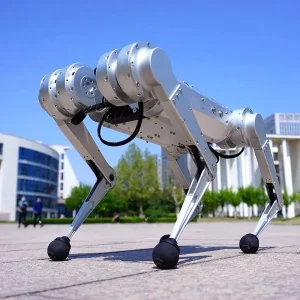
The global robotics industry is witnessing a paradigm shift with the emergence of Lightweight Quadruped Robots (LQR). Unlike their bulky predecessors used primarily in research labs, today's "robot dogs" are agile, cost-effective, and increasingly intelligent. From North America to East Asia, the commercial and industrial demand for four-legged bionic systems has skyrocketed, driven by breakthroughs in battery density, high-torque servo motors, and AI-driven locomotion control.
Annual Growth Rate in Industrial Robotics
Ultra-Lightweight Portable Designs
All-Weather Operational Standards
Edge Computing Integration
In the current industrial context, lightweight quadruped robots are no longer just "gadgets." They are becoming essential tools for Remote Inspection, Security Patrols, and Disaster Response. Major tech hubs in Germany, the USA, and China are competing to produce the most efficient "Bionic Dogs" that can navigate complex terrains where traditional wheeled or tracked robots fail.
Modern quadruped robots are now being equipped with Large Language Models (LLMs), allowing them to understand natural language commands and interact with humans more intuitively.
The shift towards lightweight materials like carbon fiber and high-strength aluminum has extended battery life from 45 minutes to over 4 hours in some industrial models.
360° LiDAR and Depth Cameras (D-Cameras) have become standard, enabling robots to create real-time 3D maps and navigate autonomously in GPS-denied environments.
The trend is moving toward collaborative robotics. We are seeing factories where "robot dogs" work alongside human technicians, carrying tools, monitoring gas leaks, and ensuring safety protocols are followed. The miniaturization of components allows these robots to be carried in a backpack, opening up "Search and Rescue" (SAR) opportunities in mountainous terrains or earthquake zones.
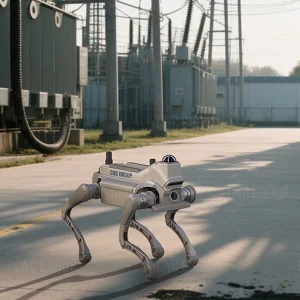
Global energy companies are the primary buyers of bionic quadruped robots. These machines can climb stairs in substations, read analog gauges via computer vision, and detect thermal anomalies that might indicate a pending transformer failure.
Lightweight robots are being deployed for inventory management in complex warehouses. Unlike AGVs, quadruped robots can step over fallen boxes or navigate uneven outdoor loading docks.
In hazardous environments—such as chemical spills or post-explosion sites—first responders deploy lightweight quadruped robots to relay real-time video and sensor data without risking human lives.
As a leading manufacturer in Hangzhou, China, we offer unparalleled advantages in the lightweight quadruped robot market:
Our location in the heart of China's tech hub gives us access to world-class motor, sensor, and battery suppliers, reducing lead times by 40% compared to international competitors.
We iterate our software and hardware monthly. From the Go1 series to the industrial-grade B2, our robots represent the cutting edge of bionic engineering.
We provide enterprise-grade bionic solutions at a fraction of the cost of Boston Dynamics' Spot, making advanced robotics accessible to SMEs and research institutions.

Bringing intelligent robots into every family, and making everyday life more convenient and intelligent.

With intelligent robot as the carrier and AI technology as the core, we aim to build an intelligent eco-system with hardware, software, service and content all integrated together.

Creativity, Resilience, Collaboration, Straightforwardness
Established in March 2012, Hangzhou Excitech Technology Co., Ltd. is a leading humanoid robots and smart service robots company. On 29 December, 2023, we were listed on the main board of the Hong Kong Stock Exchange (stock code: 9880.HK), and have become the first humanoid robot company listed on Hong Kong Stock Exchange.
Dedicated to the mission of 'bringing intelligent robots into every family, and making everyday life more convenient and intelligent', we have developed a full stack of humanoid robotic technologies independently. Building on our full-stack technologies, Excitech has engaged in the research and development, design, smart production, and commercialization of smart service robots, and has developed smart robotic solutions that integrate with hardware, software, service and contents.
Excitech is among the few global leaders in full-stack humanoid robotics technologies. Our full-stack technologies are a holistic combination of industry-leading robotic technologies (robotic motion planning and control technology, and high performance servo actuators), our AI technologies (human-like brain function and cerebellum function), integrated robotic and AI technologies (SLAM and autonomous technology, visual servo operation and human-robot interaction), and Robot Operating System Application Framework (ROSA 2.0), our proprietary robotics application framework.
 Excitech Robot