In today's world, the safety of humans is paramount, especially in hazardous environments. Quadruped robots have emerged as essential tools in such situations. They are designed to navigate terrains that are perilous for humans. Dr. Emily Chen, a leading researcher in robotics, states, "Quadruped robots can access areas that would otherwise be unsafe for human intervention."
Why are quadruped robots used in dangerous areas? Their stability and mobility make them ideal for rugged landscapes. They can traverse rubble, steep inclines, and tight spaces with ease. This capability allows them to perform tasks like search-and-rescue or environmental monitoring where human presence poses risks.
However, these robots are not without limitations. They can struggle with unpredictable terrain and energy constraints. Understanding these challenges is crucial for enhancing their efficiency. Continuous innovation is needed to address these issues and further improve their design. Quadruped robots show promise, but the journey to optimize their function in dangerous scenarios is ongoing.
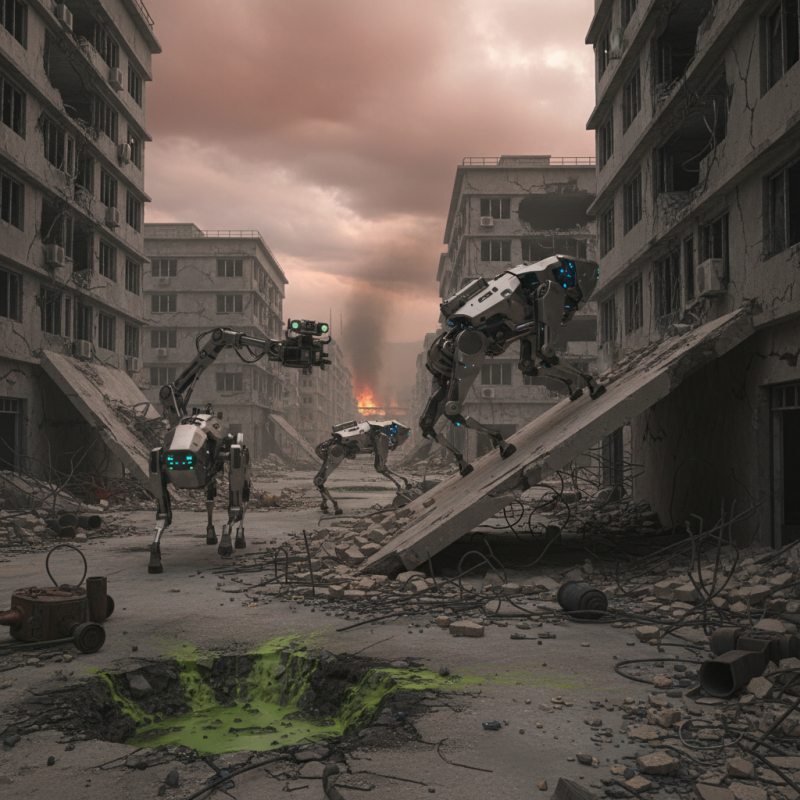
Quadruped robots are designed to navigate challenging environments with remarkable agility. Their four-legged structure provides stability on uneven terrain. This design allows them to traverse rocks, mud, and steep inclines effectively. Unlike wheeled robots, they can adjust their gait based on the surface they encounter. This adaptability is crucial in scenarios where humans cannot tread safely.
Additionally, these robots can maneuver through obstacles that would hinder traditional vehicles. Their ability to climb stairs or scale barriers expands their potential uses in search and rescue operations. They can reach victims in places where humans struggle to access. However, robotics engineers continuously face challenges in optimizing algorithms for such environments. Sometimes, the robots can be slow to react, leading to potential delays in critical moments. Improvement in this area remains a priority for researchers.
Another aspect is their use of sensors. Equipped with cameras and LIDAR, they build a map of their surroundings in real-time. This allows for smart decision-making while navigating. However, relying heavily on technology can create vulnerabilities. A sudden sensor failure can leave a robot unable to continue its mission. This is an ongoing area of focus in developing more resilient systems.
In hazardous environments, quadruped robots demonstrate remarkable stability and balance.
Their four-legged design enables them to navigate rugged terrains effortlessly.
Whether traversing rocky surfaces or crossing unstable ground, these robots maintain their footing with precision.
Each leg can adapt independently, providing resilience against sudden shifts in terrain.
This adaptability is crucial during disaster response scenarios.
The ability to manage weight distribution plays a key role in their stability.
These robots can shift their center of gravity to avoid tipping over.
This characteristic allows them to perform tasks that are risky for humans.
For instance, they can explore disaster sites without risking human lives.
Yet, even with advanced engineering, challenges remain.
Occasionally, their sensors may misinterpret the terrain.
This can lead to unexpected falls or slips.
Continuous improvement in technology is necessary to enhance their reliability further.
Quadruped robots are uniquely designed to navigate challenging environments. Their ability to carry heavy loads stands out. In hazardous areas, such as disaster zones or rough terrains, these robots demonstrate impressive strength and stability. They can transport essential supplies, like food or medical kits, without risking human safety.
Their four-legged design provides balance and traction. This makes it easier for them to traverse uneven ground. Additionally, they are often equipped with advanced sensors. These allow them to avoid obstacles and adapt to changing conditions. However, the technology can sometimes falter. Sensors might misinterpret signals or fail in extreme conditions.
The versatility of quadruped robots is remarkable. They can operate in various conditions, from deserts to icy landscapes. However, they require operator input and maintenance. Their dependence on power sources can also limit operation time. While promising, the field of quadruped robotics continues to evolve, with many challenges remaining.
This chart illustrates the strengths of quadruped robots in various challenging environments based on key performance indicators such as load capacity, terrain adaptability, battery efficiency, agility, and operational safety.
Quadruped robots are redefining mobility in tough terrains. They possess a unique ability to navigate diverse geographic landscapes. From rocky mountains to muddy swamps, these robots adjust their gait effectively. Their four legs enable stability, especially on uneven surfaces. This adaptability makes them invaluable for search and rescue missions.
When deploying quadruped robots, consider the environment. Wet and slippery grounds present challenges. Choose robots with enhanced grip features to tackle such terrains. For hilly areas, opt for models with advanced balance systems. These choices improve performance in harsh conditions.
Their versatility allows for programmed responses to various challenges. However, programming can be complex. Robotics teams must continuously refine algorithms based on field data. Experimenting with different settings often leads to insights. It is a journey of trial and error, leading to improved reliability over time. Embracing this ongoing process can enhance mission outcomes.
| Feature | Description | Advantage |
|---|---|---|
| Versatile Mobility | Ability to traverse rough terrain like rocky surfaces, mud, and snow. | Increases accessibility in hard-to-reach areas. |
| Stability | Four-legged design provides better balance compared to bipedal or wheeled robots. | Reduces risk of tipping over in unstable environments. |
| Adaptable Sensing | Equipped with various sensors to navigate and monitor surroundings. | Enhances situational awareness in hazardous conditions. |
| Payload Capacity | Can carry equipment or supplies in dangerous areas. | Facilitates rescue operations or logistics without human risk. |
| Autonomy | Capable of operating with minimal human control, often through AI. | Allows deployment in remote or dangerous situations without direct supervision. |
Quadruped robots have become essential in assessing dangerous environments, thanks to their advanced sensing and surveillance capabilities. These robots utilize various sensors, such as LIDAR and thermal imaging, to gather real-time data. According to a report by Robotics Business Review, 73% of industry experts believe that enhanced sensing technologies will revolutionize risk assessment in hazardous settings. By effectively mapping terrains, they can identify potential threats or obstacles that humans might overlook.
Integrating AI algorithms allows quadruped robots to process vast amounts of data quickly. This capability not only improves situational awareness but also enhances decision-making in emergencies. A study from the IEEE Robotics and Automation Society revealed that automated systems could reduce response time by up to 50%. This is critical when lives are at stake. However, reliance on technology can sometimes lead to overlooking human intuition, which remains invaluable.
Tips: Always combine robotic assessments with human oversight. Regular training ensures operators can interpret data correctly. Furthermore, staying updated on emerging technologies is paramount. As capabilities grow, so does the need for ethical standards to guide their use. Balancing innovation with caution is essential in leveraging these advanced robots effectively.
: Their four-legged structure offers stability and agility, allowing safe navigation on uneven surfaces.
They adjust their gait based on the terrain, enhancing their ability to traverse challenges like rocks and mud.
Equipped with cameras and LIDAR, they create real-time maps, helping them make informed decisions while navigating.
The environment is crucial; wet surfaces require robots with grip features, while hilly areas need advanced balance systems.
Robotics teams continuously refine algorithms, often through trial and error, based on field data and insights gained.
They use LIDAR and thermal imaging to gather and analyze data, enhancing risk assessment in hazardous environments.
Human intuition is valuable; operators need to interpret data accurately to complement robotic insights.
They struggle with optimizing reaction times and ensuring the robots respond quickly in critical situations.
AI algorithms help them process data swiftly, improving situational awareness and decision-making in emergencies.
Innovation should be balanced with ethical standards to ensure effective and responsible use of technology.
Quadruped robots are increasingly being deployed in dangerous environments due to their unique advantages. Their design allows them to navigate rough terrain with enhanced stability and balance, making them ideal for hazardous conditions where traditional vehicles may struggle. This capability is crucial in environments such as disaster zones or rugged landscapes, where the risk of tipping or losing control is high.
Moreover, quadruped robots can carry heavy loads, which is essential for transporting equipment and supplies in challenging conditions. Their versatile mobility enables them to traverse diverse geographic landscapes efficiently. Additionally, these robots are equipped with advanced sensing and surveillance capabilities for effective risk assessment, allowing them to gather critical data in precarious situations. Therefore, the question arises: Why are quadruped robots used in dangerous areas? Their combination of stability, load-carrying capacity, mobility, and advanced sensing technology makes them an indispensable asset in ensuring safety and efficiency in high-risk environments.
Excitech Robot