Quadruped robots are increasingly being integrated into rescue missions. Why are quadruped robots used in rescue missions? One significant reason is their ability to navigate challenging environments. According to a report from the International Federation of Robotics, rescue robots have shown a 70% increase in operational efficiency compared to traditional methods. This efficiency is crucial in emergency situations, where every second counts.
These robots can traverse debris, climb stairs, and maneuver in tight spaces. For instance, during the 2011 Fukushima disaster, robotic systems were vital for assessing unsafe areas. Their design allows them to operate in environments hazardous to human rescuers. Moreover, they can be equipped with sensors and cameras to provide real-time data. This capability enhances situational awareness in critical scenarios.
However, challenges persist. The integration of quadruped robots requires extensive training for operators. Issues like battery life and stability on uneven terrain also need optimization. Reflecting on these factors is essential to improve their effectiveness in actual missions. The potential of these robots is immense, but ongoing improvements are necessary for future deployment.
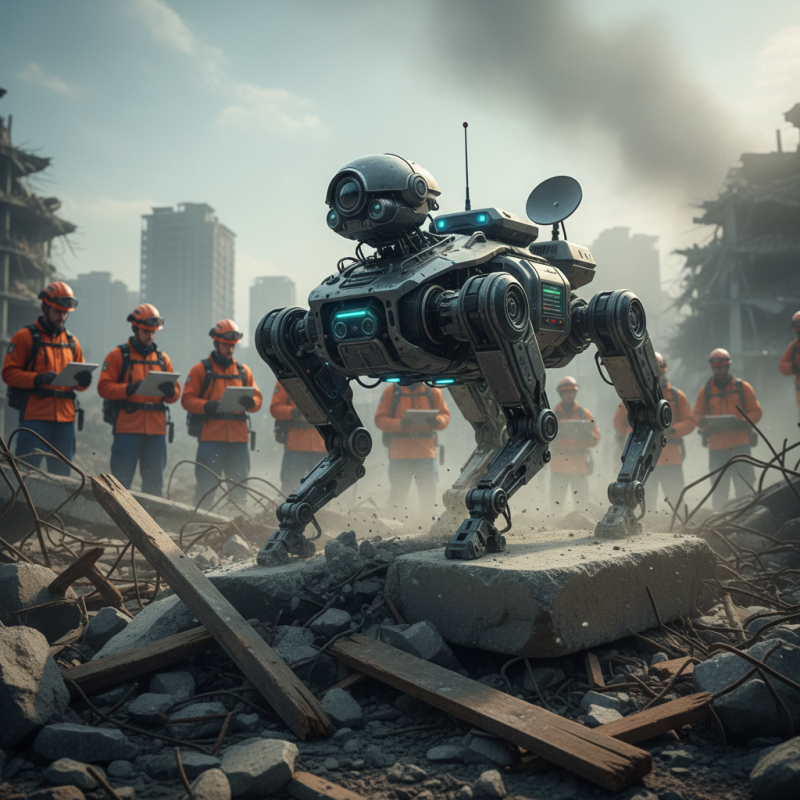
Quadruped robots are becoming increasingly valuable in rescue missions. Their unique design allows them to traverse difficult terrain where traditional vehicles struggle. This capability is crucial in disaster situations, such as earthquakes or landslides. Quadrupeds can navigate over rubble and through narrow spaces. Their four-legged structure provides stability and adaptability in unpredictable environments.
One major advantage is their ability to operate autonomously. These robots can be programmed to search specific areas, reducing the risk for human rescuers. Equipped with cameras and sensors, they can locate survivors effectively. The data collected can guide rescue teams in making informed decisions. However, they are not flawless; unexpected obstacles may hinder their progress. Testing in varied conditions is essential to improve their reliability.
Another benefit is the ability to work in teams. Multiple quadruped robots can collaborate, covering larger areas in less time. This coordinated effort can dramatically increase the chances of finding individuals in need. Yet, communication and synchronization can pose challenges. Developing protocols for seamless interaction among these machines remains an area for future exploration.
Quadruped robots are transforming rescue missions, especially in disaster zones. These agile machines navigate rough terrains where traditional vehicles fail. They employ advanced sensor technologies, including LIDAR and stereo cameras, to map their environment. Reports indicate that quadruped robots can traverse obstacles up to 30 centimeters high, making them effective in challenging scenarios.
The integration of artificial intelligence enhances their navigation capabilities. Machine learning algorithms enable real-time decision-making. A study found that AI-equipped quadrupeds can identify victims buried under debris with over 80% accuracy. This technology allows for faster responses in critical situations. However, challenges remain. Environmental factors, like heavy rain or dust, can reduce sensor effectiveness. Continuous improvement in sensor robustness is crucial.
Communication technology also plays a vital role. Reliable data transmission is essential for coordinating rescue efforts. Yet, in disaster zones, network failure is common. Innovative solutions are needed to ensure connectivity. These complexities highlight the importance of ongoing research and development in quadruped robotics. The potential is immense, but there is still much to explore and overcome.
Quadruped robots have proven to be invaluable in rescue missions. Their ability to traverse challenging terrains makes them suitable for disaster scenarios. For instance, in a recent earthquake response, a quadruped robot was deployed to search for survivors in collapsed buildings. It maneuvered through debris with ease, providing real-time data to rescue teams. This not only improved efficiency but also increased safety for human rescuers.
In another case, a quadruped robot assisted firefighters during a forest fire. Equipped with thermal imaging, it detected hotspots and potential fire spread areas. This information allowed teams to strategize their approach. However, the deployment highlighted the need for better communication between robots and human operators. Instances occurred where the robot's decisions conflicted with human judgment, causing delays in response time. Such experiences underline the importance of monitoring and refining these interactions in future missions.
The use of quadruped robots in rescue missions presents several challenges and limitations. Ground stability is a significant concern. Uneven terrain can hinder the robot’s mobility. This can affect its ability to reach victims quickly. In disaster zones, obstacles like debris complicate navigation. A quadruped robot must be adaptable to these dynamic environments.
Another limitation is the communication range. When operating in remote areas, maintaining a stable connection is critical. Disruptions can lead to loss of control and data. This uncertainty can delay rescue efforts. Additionally, the technology behind these robots often requires extensive training. Operators must understand both the mechanics and limitations. The steep learning curve can impact response times in urgent situations.
Battery life is also a pressing issue. While some robots can traverse challenging terrains, they are often power-hungry. This limits the duration they can function in emergencies. They may require frequent recharging, which is impractical in ongoing rescue operations. Overall, while quadruped robots hold promise, ongoing evaluation is necessary. Developing more resilient systems is crucial for their effective application in real-world scenarios.
Quadruped robots are transforming rescue missions, offering unique capabilities in challenging environments. Recent innovations focus on improving mobility and adaptability. Advanced sensors are being integrated, allowing these robots to navigate difficult terrains. LIDAR technology helps in mapping out areas quickly. As a result, they can reach victims faster than traditional search methods.
Another trend is enhancing their communication systems. These robots can relay data back to human operators in real-time. This creates a bridge between the field and the command center. However, issues remain regarding battery life and autonomy. Frequent recharging can hinder prolonged missions. This highlights the need for better energy solutions.
Innovation is also seen in materials used for construction. Lightweight yet durable materials allow robots to traverse rubble and debris without getting stuck. Still, scaling production for wider use is a challenge. With diverse terrains, not all quadruped designs will perform equally. Therefore, iterative testing is critical to refine their functionality.
| Feature | Application | Benefits | Future Trends |
|---|---|---|---|
| Mobility on Rough Terrain | Search and Rescue Operations | Access to hard-to-reach areas, stability | Advanced AI for obstacle navigation |
| Payload Capacity | Transporting Supplies | Ability to carry medical equipment | Integration of drones for enhanced delivery |
| Navigation and Mapping | Exploration in Hazardous Environments | Real-time hazard detection | Use of 5G technology for data transmission |
| Autonomous Operation | Remote Area Rescue | Reduces need for human presence | Self-learning algorithms for improved decision making |
| Sensor Technology | Victim Detection | Increased accuracy in locating individuals | Incorporation of thermal and infrared sensors |
: Quadruped robots use advanced sensors like LIDAR and stereo cameras to map their environment.
AI-equipped quadrupeds can identify victims buried under debris with over 80% accuracy.
Heavy rain or dust can reduce sensor effectiveness. Environmental factors complicate navigation.
Reliable data transmission ensures effective coordination during rescue efforts. Disruptions can delay responses.
It maneuvered through debris, providing real-time data to rescue teams, enhancing safety and efficiency.
Uneven surfaces can hinder mobility, affecting rapid victim access during rescue missions.
Limited battery life restricts operational duration, requiring frequent recharging in ongoing emergencies.
Operators must understand the mechanics and limitations of the robots, which can be a steep learning curve.
Yes, instances occurred where robot decisions conflicted with human judgment, causing delays.
Ongoing evaluation and development for robust systems is crucial for effective real-world applications.
Quadruped robots have emerged as vital assets in rescue missions due to their unique advantages in navigating challenging terrains, providing rapid responses in disaster zones, and accessing areas hazardous for human rescuers. Why are quadruped robots used in rescue missions? Their ability to traverse debris, climb stairs, and operate in uneven landscapes enhances the efficiency and effectiveness of search and rescue operations. Equipped with advanced navigation technologies, these robots can autonomously assess and maneuver through disaster areas.
Successful case studies have demonstrated the effectiveness of quadruped robots in real-world scenarios, showcasing their capabilities to locate survivors and deliver essential supplies. However, challenges such as battery life, communication in complex environments, and the physical limitations of these robots remain significant. Looking ahead, innovations in robotics technology promise to address these challenges, paving the way for even more effective applications of quadruped robots in future rescue missions.

Excitech Robot