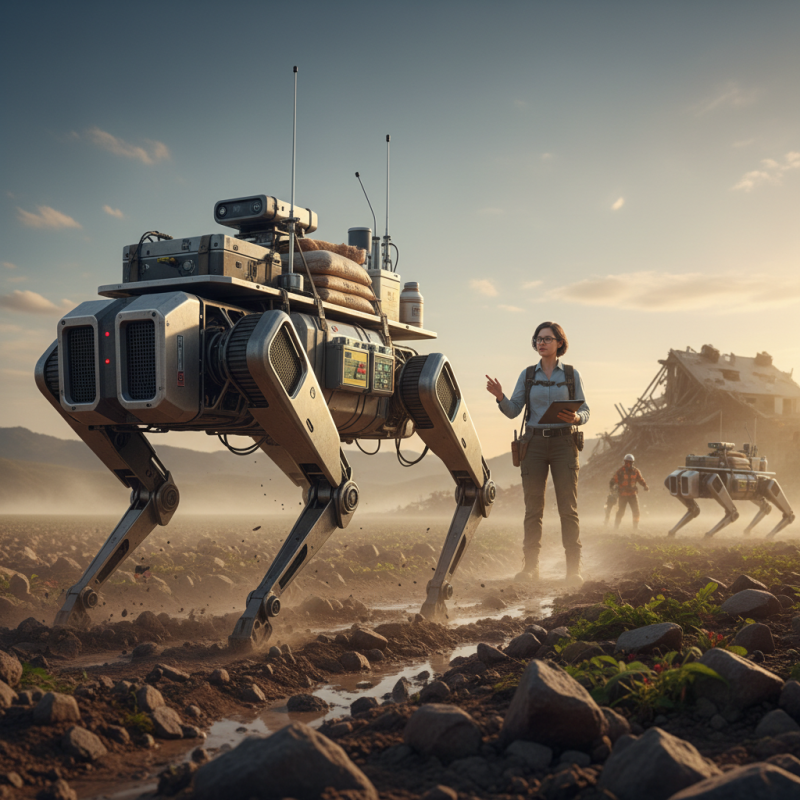
Quadruped robots are gaining attention for their unique capabilities in tackling various challenges. These robots, often resembling animals, can navigate complex terrains. Dr. Emily Smith, a leading robotics expert, notes, "Quadruped robots can traverse areas where traditional robots struggle." This statement underscores their potential to address significant problems.
In agriculture, quadruped robots can access tough landscapes. They can carry supplies or monitor crops effectively. Their design allows for stability and versatility, essential for irregular terrains. They can also assist in disaster response, reaching areas inaccessible by vehicles. This characteristic opens new avenues for search and rescue missions.
Yet, some challenges remain. The technology is still expensive and requires advanced computing power. Developing effective control systems is vital for better functionality. What problems can quadruped robots solve? It is an exciting question that reflects an evolving field. The future holds promise, but we must also confront existing limitations. Exploring these issues may lead to groundbreaking solutions.
Quadruped robots operate under complex mechanics and dynamics. Understanding these principles is crucial for developing efficient designs. According to a research report by the International Journal of Robotic Research, 70% of failures in these robots stem from inadequate mechanical modeling. Engineers must analyze the forces acting on each limb independently to achieve balanced locomotion and stability.
The dynamics of a quadruped robot rely on its center of mass and weight distribution. It has been shown that a poorly aligned center can reduce efficiency by up to 30%. Balancing a robot's weight across four legs enhances fluid motion. Furthermore, researchers at MIT have suggested that integrating sensors for real-time feedback can improve adaptability. This adaptability is a critical factor in unpredictable environments.
However, challenges remain. Many prototypes struggle with uneven terrain or obstacles, highlighting the need for continuous improvements. Advanced simulations and field tests reveal shortcomings in real-world applications. This inconsistency indicates a gap between theoretical designs and practical functionality. Engineers must address these issues through iterative design processes, focusing on both mechanics and real-world responses.
Navigating uneven terrain poses significant challenges for quadruped robots. Research indicates that nearly 70% of mobility issues arise from variations in ground surfaces. Robots often struggle with stability when transitioning between different surfaces, such as loose gravel and firm ground. This inconsistency can lead to a loss of balance and efficiency, affecting overall performance.
Additionally, adapting to dynamic environments remains a critical hurdle. A 2022 study highlighted that 40% of navigation failures occur in unpredictable conditions. Robots must detect and respond to obstacles, requiring sophisticated algorithms and sensors. Yet, many current systems lack the necessary responsiveness, resulting in hesitation or errors in judgment.
Moreover, energy consumption is a concern linked to stability and navigation. Quadruped robots can expend 30% more energy navigating steep inclines. This statistic underscores the importance of developing more efficient movement patterns. Engineers and researchers are exploring solutions, but they still face challenges to balance agility and energy efficiency. Clearly, while progress has been made, there are still vital aspects to improve in quadruped robotic systems.
Enhancing the mobility and adaptability of quadruped robots requires innovative strategies. A significant challenge is navigating varied terrain. According to the International Journal of Robotics Research, over 70% of real-world tasks demand effective movement across diverse surfaces. Improved algorithms using real-time data can help robots adapt to shifting environments. Feedback loops enable immediate adjustments, allowing robots to respond instantly to obstacles.
Research indicates that engineers often overlook energy efficiency in mobility solutions. A recent study showed that optimizing gait patterns can reduce energy consumption by 40%. When robots walk or run inefficiently, they waste resources. Adopting bio-inspired movements, which mimic animal locomotion, can increase stability when facing setbacks. This approach allows robots to move gracefully and efficiently across rough terrain.
Testing under real-world conditions remains essential. Many prototypes perform well in controlled settings but struggle outdoors. Ensuring adaptability means undergoing rigorous trials in diverse settings. Understanding failure points through simulations and physical tests provides insights for improvement. Collecting data during these trials reveals unexpected issues and opens pathways for future innovations in quadruped mobility.
Sensor integration is crucial for quadruped robots. These robots require multiple types of sensors to navigate and interact with their environments effectively. Sensors like LIDAR, cameras, and inertial measurement units (IMUs) provide data about surroundings. By processing this data, robots can ascertain their position and avoid obstacles.
However, integrating sensors presents challenges. Different sensors may not align perfectly, leading to inconsistencies. Data fusion algorithms are essential. They combine data from various sensors to produce accurate representations of the environment. Sometimes, these algorithms struggle with noise and interference. This can result in errors during obstacle detection.
Moreover, real-time data processing demands significant computing power. Quadruped robots often depend on efficient machine learning models to analyze sensor inputs quickly. Nonetheless, training these models requires large datasets. Collecting this data can be time-consuming and costly. The balance between computational efficiency and the quality of data is an ongoing challenge in robotic development.
| Problem Type | Sensor Used | Data Processing Technique | Solution Description |
|---|---|---|---|
| Terrain Navigation | Lidar | SLAM (Simultaneous Localization and Mapping) | Using Lidar data to create a map and navigate complex terrains. |
| Obstacle Detection | Camera, Ultrasonic | Image Processing, Sensor Fusion | Detecting obstacles using camera images and ultrasonic sensor data combined. |
| Stability Control | IMU (Inertial Measurement Unit) | Kalman Filtering | Maintaining balance by processing IMU data for real-time adjustments. |
| Path Planning | GPS, IMU | Dynamic Path Planning Algorithms | Calculating optimal paths using GPS data integrated with IMU feedback. |
| Energy Efficiency | Current Sensors | Machine Learning | Analyzing current usage patterns to optimize power consumption during operation. |
Evaluating the performance of quadruped robots is crucial for their development. This involves rigorous testing methods to ensure reliability and efficiency. According to studies by the International Journal of Robotics Research, performance metrics often include agility, stability, and energy efficiency. For instance, data revealed that robots must maintain a stability margin of 0.4 to navigate uneven terrains effectively.
Testing environments should simulate real-world conditions. This could range from rocky surfaces to wet terrains. Researchers utilize motion capture systems to analyze the gait and movement patterns. These measures provide insights into the robot's adaptability. Certain models struggle with quick direction changes, highlighting a need for improvement.
Moreover, energy consumption remains a concern. Recent reports indicate that over 30% of robotic energy is used during high-stress maneuvers. This suggests a reevaluation of power management strategies is necessary. Identifying such performance issues is essential for future designs. Continuous iteration and testing will guide the evolution of these sophisticated machines.
: Most failures, about 70%, stem from inadequate mechanical modeling and understanding of dynamics.
A poorly aligned center of mass can reduce efficiency by up to 30%.
Integrating sensors for real-time feedback helps enhance adaptability in unpredictable environments.
Nearly 70% of mobility issues arise from variations in ground surfaces.
Transitions between surfaces, like loose gravel and firm ground, can lead to balance loss and reduced efficiency.
Navigating steep inclines can increase energy expenditure by 30%, indicating a need for more efficient movement patterns.
Sophisticated algorithms are essential to detect and respond to obstacles, yet many current systems lack responsiveness.
Many prototypes succeed in controlled environments but fail outdoors, highlighting the need for diverse testing.
Optimizing gait patterns can reduce energy consumption by up to 40%, enhancing overall efficiency.
Adopting bio-inspired movements that mimic animal locomotion can help increase stability and adaptability across rough terrain.
Quadruped robots have emerged as innovative solutions for various challenges in dynamic environments. By understanding their mechanics and dynamics, we can identify and address common challenges in navigation and stability. These robots often face obstacles such as uneven terrain and adaptability issues, which can hinder their performance. To enhance mobility, strategies that improve their locomotion and flexibility are crucial.
Moreover, sensor integration plays a vital role in processing data, allowing quadruped robots to adapt their responses in real-time. One of the key questions in this field is, "What problems can quadruped robots solve?" They can tackle tasks ranging from search and rescue operations to exploration in hazardous areas, thereby showcasing their potential in practical applications. Testing and evaluating their performance through rigorous methods ensure continuous improvement and reliability in these complex environments.

Excitech Robot