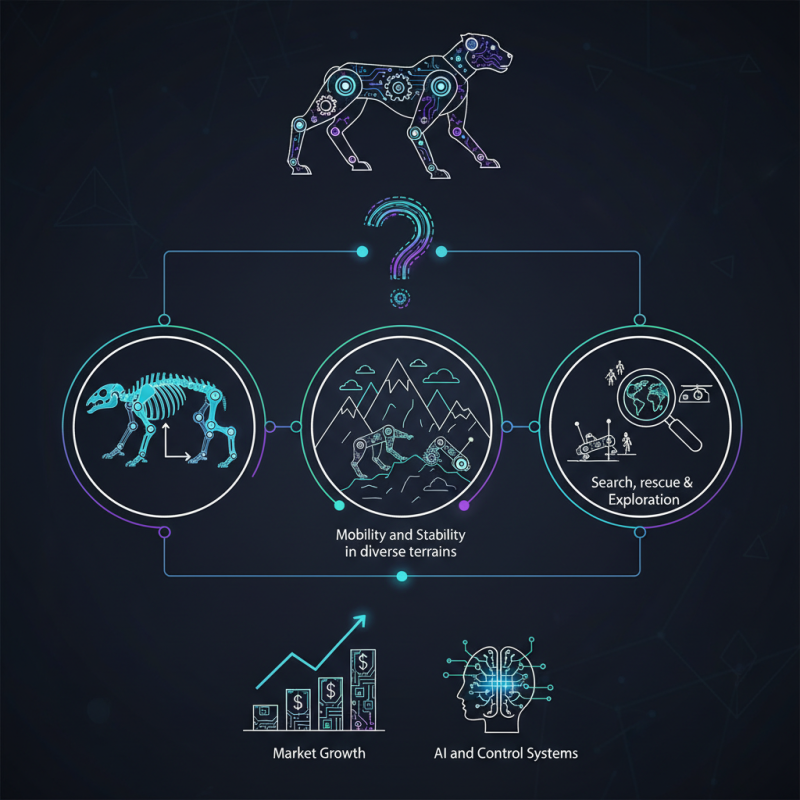
Quadruped robots have garnered substantial interest in the fields of research and development. Why are quadruped robots important for research? These robots replicate animal locomotion, providing valuable insights into biomechanics. According to a report from the International Journal of Robotics Research, quadrupedal systems contribute to advancements in both mobility and stability in unpredictable environments.
In various studies, quadruped robots have demonstrated their ability to traverse diverse terrains that typical wheeled robots struggle with. The versatility of these machines showcases their potential for applications in search and rescue operations, as well as exploration missions in remote areas. Yet, challenges remain in optimizing their energy consumption and sensory feedback.
The global market for robotic systems is projected to reach $222 billion by 2026, amplifying the importance of quadruped robots in bridging gaps between robotic design and real-world applications. With a focus on robust control systems and artificial intelligence, researchers are finding new ways to enhance the functionality of quadrupedal robots. While progress is evident, there is ample opportunity for reflection and improvements in their design and functionality.
The Evolution of Quadruped Robots in Robotics Research
The evolution of quadruped robots has significantly shaped the landscape of robotics research. These versatile machines mirror the movements of animals, enabling them to traverse diverse terrains. Researchers have extended this design to enhance stability, agility, and speed. Challenges remain, like navigating uneven surfaces or obstacles. However, each trial leads to improvements in their algorithms and design.
Studying quadruped robots offers insights into locomotion and balance. When engineers program these robots, they often face unexpected behavior. A minor tweak might improve control but complicate responsiveness. This highlights a critical aspect of robotic development: the balance between flexibility and predictability. Moreover, learning from failures is essential. Each misstep provides valuable data, driving innovation in this field. The integration of artificial intelligence is also ongoing. As robots evolve, so do their capabilities. They must adapt to ever-changing environments and conditions.
Why Are Quadruped Robots Crucial for Research and Development?
| Dimension |
Description |
Significance |
| Mobility |
Ability to traverse various terrains |
Essential for outdoor exploration and rescue missions |
| Stability |
Maintain balance while navigating obstacles |
Critical for operations in unstable environments |
| Versatility |
Adaptability to different functions (e.g., surveillance, delivery) |
Increases the range of applications in various fields |
| Navigation |
Integration of advanced sensors for real-time navigation |
Enhances efficiency in complex environments |
| Energy Efficiency |
Utilization of hybrid locomotion systems |
Prolongs operational time in field missions |
Key Advantages of Quadruped Robots Over Other Robot Designs
Quadruped robots have gained traction in research and development due to their unique advantages. Their four-legged design offers superior stability and mobility compared to bipedal robots or wheeled devices. A study by the International Journal of Robotics Research highlights that quadruped robots can traverse uneven terrain, which is crucial for applications in search and rescue operations. This capability allows them to operate in environments where traditional robots struggle.
The versatility of quadruped robots extends to their adaptability in various tasks. According to a report from the IEEE Robotics and Automation Magazine, these robots can support load carriage, assist in logistics, or conduct surveillance. Their ability to mimic animal locomotion provides them with excellent agility. However, developing these robots involves complexities, such as balancing energy efficiency with performance. Researchers constantly seek to improve algorithms controlling locomotion, ensuring better energy usage without sacrificing speed or stability.
Quadruped robots face limitations too. While they excel in rough terrains, they may not be the best choice for flat surfaces where wheeled robots perform better. Additionally, the complexity of control systems can lead to increased development time and costs. Nonetheless, the ongoing advancements in sensors and machine learning technologies promise to enhance the capabilities of quadruped robots. These efforts underline the importance of continuous research in optimizing their designs and expanding their utility across various sectors.
Applications of Quadruped Robots in Real-World Scenarios
Quadruped robots are increasingly making their mark in various real-world applications. These robots mimic the locomotion of four-legged animals, enabling them to navigate challenging terrains. They find use in search and rescue operations, where their agility allows them to access hard-to-reach areas. Their sturdy design helps them withstand harsh environments, making them reliable partners in emergencies.
Another area of application is agriculture. Quadruped robots can traverse uneven farmland, performing tasks like monitoring crops or assisting in planting seeds. This can lead to improved efficiency and productivity. However, their integration into agriculture raises questions about the balance between technology and traditional farming methods. There is ongoing debate over the potential loss of jobs versus the benefits of automation.
In the realm of military and security, quadruped robots enhance surveillance capabilities. They can patrol areas autonomously, reducing risk to human personnel. Yet, this raises ethical considerations about the use of robots in security roles. It prompts a re-evaluation of human oversight and control in sensitive situations. Overall, while quadruped robots present exciting possibilities, they also necessitate thoughtful discussion on their implications in society.
Challenges in Designing and Implementing Quadruped Robots
The design and implementation of quadruped robots present unique challenges for researchers and developers. One major issue is achieving stable locomotion. According to a recent report by the International Journal of Robotics Research, over 50% of robotic failures in field tests stem from balance and movement errors. Engineers must constantly refine algorithms to enhance gait patterns and stability on varying terrains.
Power efficiency is another obstacle. Quadruped robots require substantial energy for their motors, impacting operational endurance. Studies indicate that optimizing energy consumption can improve battery life by up to 30%. Developers are experimenting with bio-inspired designs to mimic animal movement, which may lead to breakthroughs in efficiency.
Tip: Incorporating advanced materials can significantly reduce weight, improving agility and energy consumption.
Software integration poses its own set of challenges. Creating a seamless interaction between hardware and software components is critical. Many teams report lengthy debugging processes. Inadequately tested software can lead to unpredictable robot behavior. This emphasizes the need for thorough simulations before real-world deployment.
Tip: Regularly update and test simulation environments to catch errors early in the development process.
These hurdles highlight the complexities inherent in developing effective quadruped robots. The path forward requires a mix of innovation, testing, and refinement.
Future Trends and Innovations in Quadruped Robot Development
Quadruped robots are at the forefront of innovation in robotics. Recent industry reports predict a compound annual growth rate (CAGR) of 22% in the quadruped robot segment by 2026. This growth is driven by advances in mobility, autonomy, and artificial intelligence. Researchers are exploring how these robots can navigate complex terrains. They are improving algorithms for efficient movement, enabling applications in rescue operations and exploration.
Current trends include enhancing sensory technology. Robots are now equipped with better cameras and LIDAR systems. These upgrades allow them to perceive their environment with greater accuracy. A study by the International Journal of Robotic Engineering highlights a 30% increase in navigational accuracy with these innovations. Yet, challenges remain. The integration of AI in controlling these robots raises concerns about reliability and safety. The lack of a standardized framework for testing remains an obstacle for developers.
There is a growing interest in swarm robotics as well. This methodology mimics natural behaviors seen in animals. While promising, coordination among multiple quadruped robots is complex. Issues related to communication can hinder efficiency. Moreover, predictions of future applications must account for ethical usage. The potential for misuse in surveillance raises questions. Industry stakeholders must navigate these challenges to harness the full potential of quadruped robots.
FAQS
: Quadruped robots mimic animal movements and can traverse various terrains. They aim for enhanced stability and agility.
Achieving stable locomotion is a significant challenge. Many failures result from balance and movement errors during testing.
Optimizing energy consumption can enhance battery life by up to 30%. This reduces operational endurance issues.
Seamless interaction between hardware and software is critical. Poorly tested software can lead to unpredictable robot behavior.
AI helps robots adapt to changing environments and enhances their capabilities as they evolve.
They learn about locomotion and the challenges of maintaining balance during movement on uneven surfaces.
It may improve control but can complicate the robot's responsiveness, highlighting a design dilemma.
Each failure provides valuable data that drives innovation and improvement in robot design and functionality.
Incorporating advanced materials can reduce weight, enhancing both agility and energy consumption.
Regular updates and testing of simulations can catch errors early, reducing lengthy debugging in real-world applications.
Conclusion
Quadruped robots play a vital role in research and development, primarily due to their unique mobility and stability that mimic animal locomotion. The evolution of these robots has significantly advanced robotics research, leading to key advantages such as superior balance, obstacle negotiation, and adaptability in diverse environments compared to other robot designs. Applications range from disaster response and search-and-rescue operations to agricultural tasks, showcasing their versatility in real-world scenarios.
However, designing and implementing quadruped robots comes with challenges, including mechanical complexities and the need for refined control systems. Looking ahead, future trends in quadruped robot development are expected to focus on enhancing autonomy and integrating artificial intelligence, further underscoring the question: why are quadruped robots important for research? Their ongoing advancements not only propel technological innovation but also contribute to a better understanding of locomotion, biomechanics, and environmental interaction.

 Excitech Robot