China Top Quadruped Robots What Materials Are Used?

Time:2026-09-17 Author:Henry
0%

What materials are used in quadruped robots is a practical question, not merely a design detail. China’s leading quadruped platforms often combine 6061 or 7075 aluminum alloys, carbon-fiber composites, engineering plastics, copper windings, steel gears, and elastomeric foot pads. Each material affects weight, stiffness, heat transfer, shock absorption, and repair cost.

The International Federation of Robotics reported about 205,000 professional service robots sold worldwide in 2023, representing strong annual growth in a rapidly expanding sector. IDTechEx’s Mobile Robots 2024–2044 analysis also highlights lighter structures, higher battery energy density, and improved actuator efficiency as major development priorities. These findings help explain why Chinese manufacturers, including Unitree and DEEP Robotics, increasingly use aluminum frames with composite covers. Aluminum keeps the legs manageable. Carbon fiber can reduce shell weight. Steel remains difficult to replace inside high-load transmissions.

Performance is not only about weight. Marc Raibert, founder of Boston Dynamics, has said, “The goal is to make robots that are as agile, as capable, and as robust as animals.” That principle exposes an uncomfortable truth: no single material solves every engineering problem. A carbon shell may crack under a sharp impact. A metal joint may survive abuse but increase motor demand. Some public specifications remain incomplete, so comparisons require caution. Battery cells, seals, thermal pads, and foot compounds also deserve attention. Small components matter. This introduction examines the material choices behind China’s top quadruped robots, connecting laboratory ambitions with visible details, such as textured rubber feet, ribbed aluminum housings, and warm actuator covers after demanding climbs.
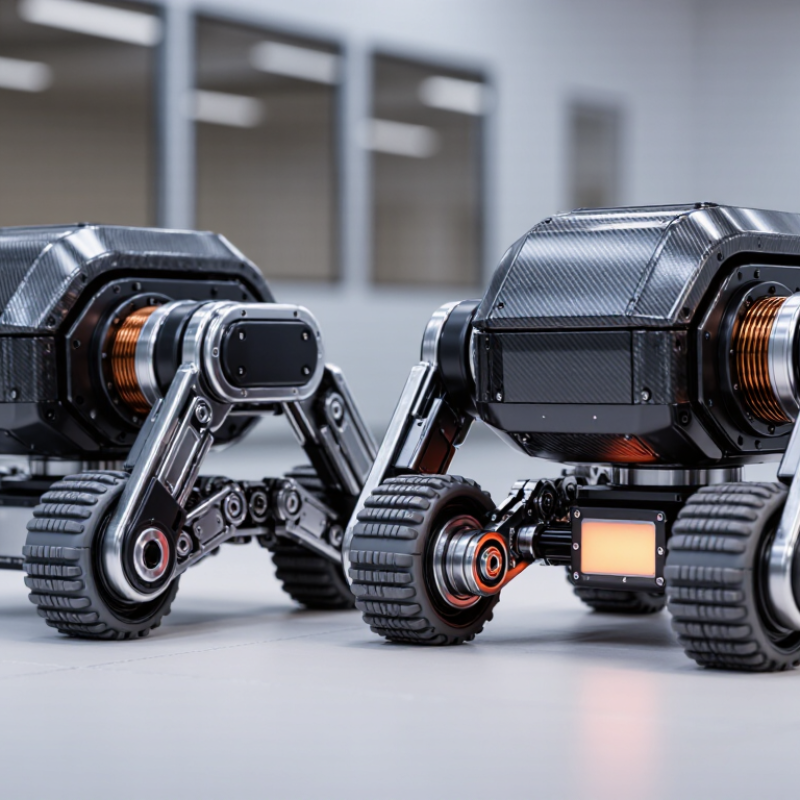
China Top Quadruped Robots What Materials Are Used?

What Are China’s Top Quadruped Robots?

China’s top quadruped robots are defined by practical performance, not appearance. Leading models usually combine aluminum alloy frames, reinforced polymer covers, rubberized foot pads, and sealed joint housings. These materials reduce weight, protect motors, and improve traction on concrete, gravel, and wet factory floors. Their strongest features include stable walking, stair climbing, obstacle detection, and remote inspection.

Several Chinese developers now produce quadruped platforms for industrial patrols, emergency assessment, research, and education. Higher-end systems often use depth cameras, thermal sensors, lidar, and inertial units. A capable robot can inspect narrow corridors, record abnormal heat, and send live data to an operator. However, “top” depends on the task. A fast outdoor model may perform poorly indoors. A compact research unit may lack weather protection. Performance claims also need independent testing, because demonstrations rarely show every limitation.

Tips: Check walking stability, battery duration, payload capacity, sensor accuracy, and software support before choosing a model. Ask for tests on your actual flooring. Watch the joints closely. Loose movement can reveal poor calibration or early wear. Also review maintenance access and replacement-part availability. These details seem minor, but they often determine long-term reliability.

Which Materials Form Their Structural Frames?

Quadruped robot frames usually combine aluminum alloys, high-strength steel, and engineered polymers.

Aluminum offers a useful density of about 2.70 g/cm³, compared with roughly 7.85 g/cm³ for steel, according to ASM material data. This difference matters when each leg lifts repeatedly. Aluminum plates can form the torso and thigh housings, while steel inserts reinforce motor mounts, gear interfaces, and bearing seats. Those small interfaces often carry the highest local stress.

The World Robotics 2024 report recorded about 4.28 million industrial robots operating worldwide in 2023. That scale increases pressure for lighter, serviceable structures. Carbon-fiber panels can reduce mass further, but they require careful joint design and protection from impact. Magnesium alloys are lighter than aluminum, yet corrosion control and manufacturing consistency remain concerns. A light frame is not automatically a durable frame.

World Steel in Figures 2024 reported approximately 1.89 billion tonnes of crude steel production in 2023. Steel therefore remains attractive for affordable load-bearing components. In practical testing, engineers often choose hybrid frames: aluminum for the main shell, steel for concentrated loads, and polymer covers for sealing and cable protection. Titanium provides excellent strength-to-weight performance, but its machining cost can restrict wider use. The difficult part is balance. A frame may pass static testing, then fail after thousands of vibration cycles. I would not call any material choice final without fatigue data, thermal testing, and real terrain trials.

How Are Metals and Composites Used in Key Components?

China Top Quadruped Robots What Materials Are Used?

In leading Chinese quadruped robots, material selection balances weight, stiffness, heat, and repairability. According to the International Federation of Robotics World Robotics 2024 report, 541,302 industrial robots were installed globally in 2023. This scale increases pressure to build lighter and more durable platforms.

Aluminum alloys commonly form the body frame, motor mounts, and joint housings. They provide good stiffness without excessive mass. Steel appears in shafts, bearings, fasteners, and high-load gear interfaces. These parts face repeated impact during stair climbing. Heat-treated steel can resist wear, but it adds weight.

Carbon-fiber-reinforced polymer suits protective shells and selected structural panels. It reduces mass and limits vibration. However, damaged composites are harder to inspect and repair. That weakness deserves more attention.

A leg actuator may combine an aluminum housing, steel gears, copper windings, and polymer seals. The design is layered, not simple. Industry reports from MarketsandMarkets describe lightweight composites as important for aerospace and robotics because of their strength-to-weight advantages. The same principle applies here, but field conditions are harsher. Dust enters joints. Water reaches cable connectors. Carbon fiber can also create electrical-conductivity concerns near sensitive electronics. Some manufacturers may overuse composite panels for appearance rather than performance. Practical testing should measure impact resistance, fatigue life, thermal expansion, and repair time. A lighter robot is not automatically a better robot.

What Materials Protect Sensors, Motors, and Electronics?

China Top Quadruped Robots: What Materials Are Used?

In quadruped robots, materials protect more than the outer frame. They shield cameras, motors, batteries, and control boards from dust, rain, and repeated impacts. Anodized aluminum is common around electronic compartments because it is light, rigid, and resistant to corrosion. Stainless steel fasteners help maintain strength near wet joints. Some covers use reinforced engineering plastics. They reduce weight and can absorb minor collisions.

Sensors need clearer protection. Polycarbonate windows can resist scratches and sudden impacts better than ordinary glass. Silicone or fluorosilicone gaskets compress around these windows and prevent water entry. Small cable openings often use rubber seals, while flexible thermoplastic jackets protect wires during leg movement. The design must allow movement. A seal that is too tight may increase friction and fatigue the cable.

Motors face heat, vibration, and contamination. Aluminum motor housings help transfer heat away from windings. Copper plates or thermal interface materials may improve heat movement inside compact areas. Circuit boards can receive conformal coatings that reduce damage from moisture and condensation. However, coatings complicate repair. Potting compounds offer stronger protection, but technicians may struggle to replace failed components. This trade-off is easy to overlook. A thick shell is not automatically safer. Poor ventilation can trap heat, while weak seals can fail after repeated bending. Material selection should follow laboratory checks, field inspection, and realistic cleaning cycles.

China Top Quadruped Robots: What Materials Are Used to Protect Sensors, Motors, and Electronics?

Representative tensile-strength values show why different materials are combined in quadruped robot protection systems. Aluminum and stainless steel provide structural strength and heat dissipation, while PC/ABS, TPU, and silicone are commonly used for lightweight covers, shock absorption, cable sealing, and vibration isolation.

Values are representative engineering values and may vary by alloy, grade, additives, temperature, and manufacturing process. Typical uses include aluminum housings for motor and controller structures, stainless-steel hardware for exposed joints, PC/ABS covers for sensors and electronics, TPU bumpers and cable protection, and silicone seals or vibration isolators.

How Do Material Choices Affect Robot Performance?

China Top Quadruped Robots: What Materials Are Used?

Material choices strongly influence how a quadruped robot moves, works, and survives. The frame often uses aluminum alloy because it balances low weight, stiffness, and cost. Carbon fiber can reduce mass further, helping the robot lift its legs quickly and save battery power. However, carbon fiber may crack after hidden impact, making inspection more difficult.

Steel and titanium are common around joints, shafts, and high-load connections. Steel handles repeated stress well but adds considerable weight. Titanium offers strength with lower mass, yet its price and machining requirements can limit practical use. In field testing, small weight increases near the legs can reduce walking efficiency noticeably. Every gram matters.

Protective covers frequently use engineering plastics, which resist moisture and minor impacts. Rubber or thermoplastic elastomers improve foot grip on concrete, soil, and wet floors. Copper wiring supports efficient electrical transmission, while aluminum heat sinks help release motor heat. Poor thermal management can reduce torque during long missions. That is not merely a laboratory issue.

Material selection is rarely perfect. A lighter shell may be less durable, while a stronger joint may consume more energy. Engineers should test fatigue, vibration, temperature, corrosion, and impact before final production. Real surfaces are unpredictable. Dust enters gaps, feet slip, and rain changes traction. These details often expose weaknesses that computer models overlook.

China Top Quadruped Robots: What Materials Are Used? — How Do Material Choices Affect Robot Performance?
Robot Area Common Material Choices Typical Material Properties Performance Benefits Trade-Offs and Design Considerations Typical Use in Quadruped Robots
Main chassis and body frame 6061-T6 or 7075-T6 aluminum alloy; carbon-fiber-reinforced polymer for weight-sensitive structures Aluminum density: approximately 2.7 g/cm³
7075-T6 tensile strength: commonly around 500–570 MPa
Carbon-fiber composite density: commonly around 1.5–1.6 g/cm³
Reduces overall mass, improves payload-to-weight ratio, and lowers the energy required for walking and climbing. Carbon-fiber panels can provide high stiffness at low weight. Aluminum may deform under severe impact and can transmit vibration. Carbon-fiber parts are more expensive to manufacture, can be brittle under localized impact, and require careful joining. Central body shell, battery enclosure, electronics tray, structural covers, and lightweight load-bearing panels.
Leg links and upper/lower limb members High-strength aluminum alloy, carbon-fiber tubes, titanium alloy in highly loaded joints or shafts Titanium density: approximately 4.5 g/cm³
Ti-6Al-4V tensile strength: commonly around 900 MPa or higher after suitable processing
High specific strength and good corrosion resistance
Low leg inertia enables faster swing motion, more responsive foot placement, and reduced actuator torque during acceleration and deceleration. Titanium is substantially more expensive and difficult to machine than aluminum. Carbon-fiber links need robust end fittings to prevent joint damage and delamination. Thigh links, shank links, telescoping members, and components that experience repeated bending or impact loads.
Joint housings and actuator casings 6061-T6 aluminum, 7075-T6 aluminum, ductile iron or steel for highly loaded mounting interfaces Good machinability and heat dissipation for aluminum; higher stiffness, wear resistance, and impact tolerance for steel-based interfaces Provides accurate bearing alignment, protects gears and motors, and transfers joint loads into the leg structure. Steel increases mass and can raise the robot's leg inertia. Aluminum requires sufficient wall thickness and proper bearing-seat design to avoid distortion. Motor housings, gearbox cases, bearing supports, actuator end caps, and structural joint brackets.
Gears, shafts, and transmission parts Hardened alloy steel, stainless steel, bearing steel, powder-metallurgy steel for selected gears High hardness, fatigue strength, wear resistance, and dimensional stability under repeated torque cycles Improves torque transmission, service life, backlash control, and resistance to shock loads when the foot contacts uneven ground. Steel components add weight and may require lubrication, heat treatment, sealing, and precise machining. Poor surface finishing can accelerate wear and noise. Reduction gears, harmonic-drive components, planetary gears, splined shafts, pins, and bearing races.
Motor magnets and electromagnetic components Neodymium-iron-boron permanent magnets, copper windings, electrical steel laminations Neodymium magnets provide high magnetic energy density; copper offers high electrical conductivity; laminated electrical steel reduces eddy-current losses Supports compact, high-torque electric actuators with good power density and controllable dynamic response. Permanent-magnet performance decreases with temperature. Copper adds mass, and motor efficiency depends strongly on thermal management, winding design, and control strategy. Brushless motor rotors and stators, integrated joint actuators, and compact high-torque drive modules.
Foot pads and ground-contact surfaces Polyurethane elastomer, natural or synthetic rubber, thermoplastic elastomer, aluminum or steel internal foot core Elastic deformation, high friction on many dry surfaces, impact absorption, and resistance to abrasion depending on formulation Improves traction, reduces impact shock, limits slipping, and helps the robot adapt to small surface irregularities. Soft materials can wear faster, collect debris, and lose friction in oil, water, or very cold conditions. Harder compounds last longer but provide less compliance. Replaceable foot soles, toe caps, contact pads, and compliant end-effectors for indoor and outdoor locomotion.
Protective covers and exterior panels ABS, polycarbonate, nylon, glass-fiber-reinforced nylon, carbon-fiber composite panels Polycarbonate offers high impact resistance; reinforced polymers improve stiffness; ABS and nylon support economical molded covers Protects motors, wiring, sensors, and batteries from dust, splashes, and minor impacts while keeping the exterior lightweight. Polymer parts can soften or deform at elevated temperatures. Outdoor ultraviolet exposure, chemical compatibility, and fastening strength must be considered. Leg guards, sensor covers, battery doors, aerodynamic fairings, and removable service panels.
Battery enclosure and thermal barriers Aluminum alloy, flame-retardant polycarbonate or nylon, mica or ceramic-based thermal barriers, silicone sealing materials Aluminum dissipates heat effectively; flame-retardant polymers provide electrical insulation; mica and ceramics tolerate high temperatures Protects cells from mechanical damage, limits heat transfer, assists thermal control, and supports safer battery operation. Metal enclosures can increase weight and require electrical isolation. Polymer barriers may have lower structural stiffness and need careful fire-retardant selection. Battery trays, cell-module separators, impact shields, cooling interfaces, and sealed battery covers.
Wiring, connectors, and flexible cable protection Tinned copper conductors, PVC or XLPE insulation, silicone cable jackets, braided textile or polymer conduit High electrical conductivity, electrical insulation, flexibility, and resistance to bending or abrasion depending on the cable construction Maintains reliable power and signal transmission while allowing repeated leg movement and reducing the risk of cable fatigue. Cables routed through moving joints can fail from repeated bending. Excess length increases mass, while insufficient slack restricts range of motion. Motor power cables, encoder wiring, sensor harnesses, joint flex cables, and protected external cable runs.
Seals, bushings, and vibration-isolation elements Silicone rubber, nitrile rubber, EPDM, polyurethane, PTFE, engineering plastics such as POM Elasticity, chemical resistance, low friction, sealing performance, and vibration damping vary by compound and operating temperature Reduces dust and water ingress, limits vibration transmission to sensors, and decreases friction or wear at selected sliding interfaces. Material compatibility with lubricants, temperature range, compression set, and abrasion resistance must be checked for each location. Rotary seals, cable grommets, shock-isolation mounts, sliding bushings, and protective joint interfaces.

Note: Property values are representative engineering ranges for commonly used material grades and can vary with alloy temper, fiber orientation, manufacturing process, heat treatment, geometry, and operating temperature. Final material selection should be verified through structural, thermal, fatigue, wear, and environmental testing.

FAQS

What makes a quadruped robot one of China’s top models?

Practical performance matters more than appearance. It should walk steadily, climb stairs, detect obstacles, and support remote inspection. “Top” depends on the work. A fast outdoor robot may struggle indoors.

Which materials are commonly used in the frame?

Many frames combine aluminum alloy, steel inserts, and engineered polymers. Aluminum keeps the main body lighter. Steel supports motor mounts, gear interfaces, and bearing seats. Polymer covers help protect cables and joints.

Why is a lightweight frame important?

Each leg lifts repeatedly during walking. Aluminum weighs about 2.70 grams per cubic centimeter, while steel weighs about 7.85. Lower weight can reduce movement demands. Light does not mean durable, though.

What sensors do advanced quadruped robots use?

Higher-end systems may include depth cameras, thermal sensors, lidar, and inertial units. These sensors can identify obstacles, detect unusual heat, and support live remote monitoring. Sensor accuracy still needs independent testing.

Where can these robots work effectively?

They can inspect narrow corridors, concrete floors, gravel, and wet factory surfaces. Rubberized foot pads can improve traction. Actual flooring matters. Test there.

Can a quadruped robot climb stairs reliably?

Many capable models are designed for stair climbing and uneven ground. However, demonstrations may hide difficult steps, loose surfaces, or poor lighting. Ask for repeated trials on the intended stairs.

How should buyers evaluate long-term reliability?

Check battery duration, payload capacity, walking stability, and maintenance access. Watch the joints during slow movement. Loose motion may indicate poor calibration or early wear. I would still want fatigue data.

Why should the frame undergo fatigue and thermal testing?

A frame may pass a static load test, then weaken after thousands of vibration cycles. Temperature changes can also affect joints, covers, and cable protection. Real terrain trials reveal problems laboratory tests may miss.

Conclusion

China’s top quadruped robots are designed for balance, mobility, inspection, research, and work in challenging environments. What materials are used in quadruped robots depends on the robot’s size, workload, speed, and operating conditions. Structural frames commonly combine lightweight aluminum alloys, high-strength steel, titanium components, and reinforced engineering plastics. These materials help create a strong yet manageable body while supporting efficient movement and reducing energy consumption.

Metals are often selected for joint shafts, gear housings, leg links, and load-bearing connections, while carbon-fiber composites and glass-fiber plastics may be used to reduce weight and improve stiffness. Protective covers and sealed enclosures made from durable polymers or corrosion-resistant alloys help shield sensors, motors, batteries, and control electronics from dust, moisture, vibration, and impact. Material choices directly influence stability, endurance, thermal management, maintenance needs, and manufacturing cost. By combining rigid, lightweight, and protective materials, modern quadruped robots can achieve a practical balance between strength, agility, reliability, and long-term performance.

Henry

Henry

Henry is a dedicated marketing professional with a profound expertise in the company's offerings. With years of experience in the industry, he possesses an impressive understanding of the market dynamics and consumer behaviors that drive success. Henry is committed to sharing his insights through......