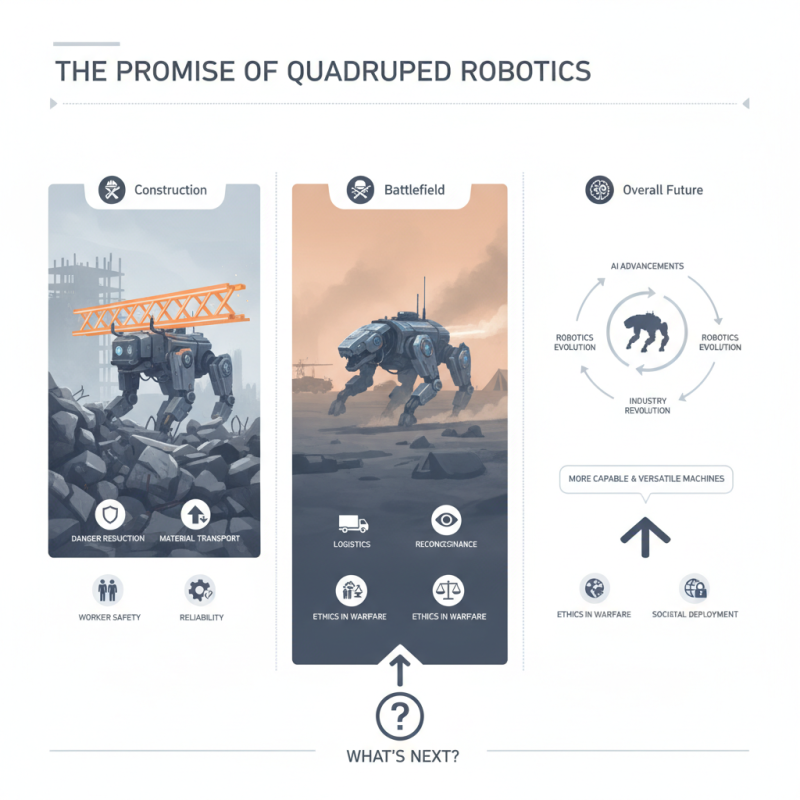
The future of quadruped robot technology holds immense promise. With advances in artificial intelligence and robotics, these machines are becoming more capable and versatile. What is the future of quadruped robot technology? Experts suggest it will revolutionize many industries.
In construction, quadruped robots may assist in tasks that are dangerous for humans. They can navigate rough terrain and carry heavy materials. However, challenges remain in ensuring they can operate safely alongside workers. Reliability is key, as failure in critical situations can lead to severe consequences.
On the battlefield, these robots could change how we approach logistics and reconnaissance. They can move swiftly and access areas that are difficult for traditional vehicles. Yet, ethical considerations about their use in warfare must be addressed. This highlights a need for careful reflection on their deployment in society.
Recent advancements in sensor technology have significantly enhanced the capabilities of quadruped robots. These robots now utilize a variety of sensors, including LIDAR and depth cameras, to navigate complex environments. This technology allows them to map their surroundings with impressive accuracy. Robots can avoid obstacles and adapt to varying terrains, thanks to real-time data processing.
Another remarkable development is in tactile sensors. These sensors imitate the way animals sense their environment through touch. Quadruped robots equipped with such sensors can grip objects delicately or traverse uneven surfaces without losing balance. This not only improves their functionality but also their safety in interactions with humans and additional machinery.
However, challenges remain. Sensors can be affected by environmental conditions, which may lead to inaccuracies. Moreover, the integration of multiple sensor types can introduce complexity into software systems. This might lead to communication issues between sensors and processing units. Continuous improvements are necessary to overcome these hurdles and ensure reliability in real-world applications. Quadruped robots will play a crucial role in various sectors, but refining sensor technology is key to unlocking their full potential.
Quadruped robots are gaining attention due to their advanced locomotion algorithms. These algorithms enable agile movement across various terrains. A report from the International Journal of Robotics Research suggests that these enhancements can improve speed and adaptability by around 30%. This increased agility opens new applications in search and rescue missions, agriculture, and even exploration.
The ability to navigate complex environments is a significant advantage. Many current robots struggle in uneven terrain or slippery conditions. Recent simulations indicate that quadruped robots with improved algorithms can effectively bypass obstacles, enhancing productivity. However, the technology is not perfect. Difficult weather conditions, such as heavy rain or snow, still pose challenges.
Moreover, the energy efficiency of these robots needs further optimization. Preliminary studies show that while locomotion algorithms improve speed, they may also increase power consumption. This paradox requires a thoughtful approach to balance agility and energy use. The future is bright, but crucial adjustments are necessary to realize the full potential of quadruped robots.
This chart illustrates the performance metrics of quadruped robots powered by enhanced locomotion algorithms. Metrics such as agility, stability, energy efficiency, speed, and terrain adaptability show promising scores, indicating significant advancements in robotic movement efficiency.
Quadruped robots are gaining traction in various industries due to their versatile design and efficiency. In agriculture, these robots can navigate rough terrains easily. They help with tasks like monitoring crops and transporting goods. Their agility can reduce labor costs significantly. Many farmers report that these robots can work in conditions that humans find challenging.
In emergency response, quadruped robots prove invaluable. They can access disaster-stricken areas where humans cannot. Search and rescue missions benefit from their ability to maneuver through debris. These robots often carry sensors to locate survivors. However, operators must balance automation with human decision-making. The technology is promising, but there’s still room for improvement.
The potential for quadruped robots in logistics is also noteworthy. They can assist in warehouses by moving items efficiently. However, some robots struggle with complex layouts. Users must consider this limitation when integrating them into existing systems. Creating a seamless workflow is crucial for effectiveness. Innovators are working to refine navigation systems for better adaptability.
| Industry | Application | Benefits |
|---|---|---|
| Agriculture | Crop monitoring and management | Increased efficiency in field management |
| Construction | Site surveying and material transportation | Enhanced safety and reduced labor costs |
| Military | Reconnaissance and logistics support | Improved operational efficiency with minimized risks |
| Healthcare | Patient delivery and monitoring | Enhanced patient care and support |
| Search and Rescue | Navigating difficult terrain for locating individuals | Faster response times in emergencies |
| Entertainment | Interactive robotic performances | Engagement and creativity in exhibitions |
The development of quadruped robots faces several significant challenges. One major hurdle lies in their balance and stability. These robots can easily tip over, especially on uneven terrain. A 2021 report from the International Journal of Robotics Research indicated that over 45% of falls occur during navigation on complex surfaces. Achieving reliable balance control requires advanced algorithms and sensors, which can escalate costs.
Power efficiency is another critical issue. Quadruped robots often require substantial energy to operate effectively. According to a study by the IEEE Robotics and Automation Society, power consumption can exceed 50% compared to bipeds for similar tasks. Developing lightweight materials and more efficient motors is essential to address this. However, finding the right balance between weight reduction and structural integrity remains tricky.
Finally, software integration presents unique challenges. Programming these robots to understand diverse environments is complex. The need for machine learning and artificial intelligence further complicates this process. Industry experts suggest that roughly 30% of development resources are spent solely on software improvements. Continuous testing and adaptation are vital for refining their capabilities in real-world scenarios.
Quadruped robots are gaining traction in various sectors, driven by their unique design and mobility. Future trends indicate a shift towards more adaptable and versatile robots. According to a recent report by Research and Markets, the global quadruped robot market is projected to reach $1.3 billion by 2027, growing at a compound annual growth rate (CAGR) of 26.1%. This growth reflects increased investment in research and development, pushing the boundaries of robotics and AI.
Innovations in material science play a critical role. Lightweight materials like carbon fiber and advanced polymers enable enhanced mobility and energy efficiency. These advancements allow robots to traverse complex terrains with greater ease. As robots become more adept in handling unpredictable environments, applications in search and rescue missions or disaster response become increasingly viable. Designers must keep in mind, however, that with increased functionality comes the challenge of maintaining reliability and safety in diverse conditions.
Ethical considerations will also shape future design. Concerns about autonomy and decision-making in unpredictable scenarios require careful exploration. As developers strive to create robots that can operate independently, reflections on ethical programming will be crucial. Balancing autonomy with safety presents a challenging dilemma that needs continuous attention and refinement.
: Balance and stability are significant challenges. They easily tip over on uneven surfaces.
Over 45% of falls happen on complex terrains. This issue hinders their effective operation.
Quadruped robots consume more power than bipeds. Energy use can exceed 50% for similar tasks.
Lightweight materials like carbon fiber are crucial. They enhance energy efficiency and mobility.
Programming robots for diverse environments is complex. Software improvements take up about 30% of development resources.
Expect more adaptable robots in various sectors. The market is projected to reach $1.3 billion by 2027.
Ethical programming is essential for robotic autonomy. Balancing safety and decision-making presents challenges.
Search and rescue missions might benefit from their capabilities. Enhanced mobility is a key factor.
Increased functionality may complicate reliability. Diverse conditions pose more risks for operational safety.
The future of quadruped robot technology looks promising due to significant advancements in sensor technology and locomotion algorithms. These improvements are facilitating more agile movements and enhancing the overall capabilities of quadruped robots. Various industries, including agriculture, logistics, and search and rescue, are beginning to leverage these robots for their versatility and efficiency in navigating complex environments.
However, challenges remain in the development of quadruped technology, such as improving stability and energy efficiency. Despite these hurdles, the ongoing dedication to research and innovation is paving the way for future trends in design that promise to elevate the functionality and application of quadruped robots. As we explore "what is the future of quadruped robot technology," it becomes evident that continued investment in these areas will unlock new possibilities and applications across diverse fields.
Excitech Robot