The evolution of quadruped robots has gained significant attention in robotics. Understanding what affects the stability of a quadruped robot is essential for their practical applications. Recent studies indicate that approximately 45% of robotic failures in dynamic terrains are due to instability issues. Factors like weight distribution, terrain adaptability, and sensor accuracy play crucial roles.
Weight distribution is critical for maintaining balance. A quadruped robot’s center of gravity needs careful management. Moreover, the choice of materials affects both stability and durability. Terrain adaptability is another significant factor. In research, it was found that robots struggle on uneven surfaces, with up to 60% performance loss. Sensor accuracy impacts a robot’s ability to react to environmental changes. Even with advanced sensors, there can be delays in feedback that compromise stability.
The pursuit of stability in quadruped robots poses challenges. Designers often overlook the complex interplay between mechanical design and software algorithms. Most existing robots still fail under specific conditions, revealing a gap in our understanding. Continuous reflection and innovation are vital as the industry moves toward more capable robotic systems.
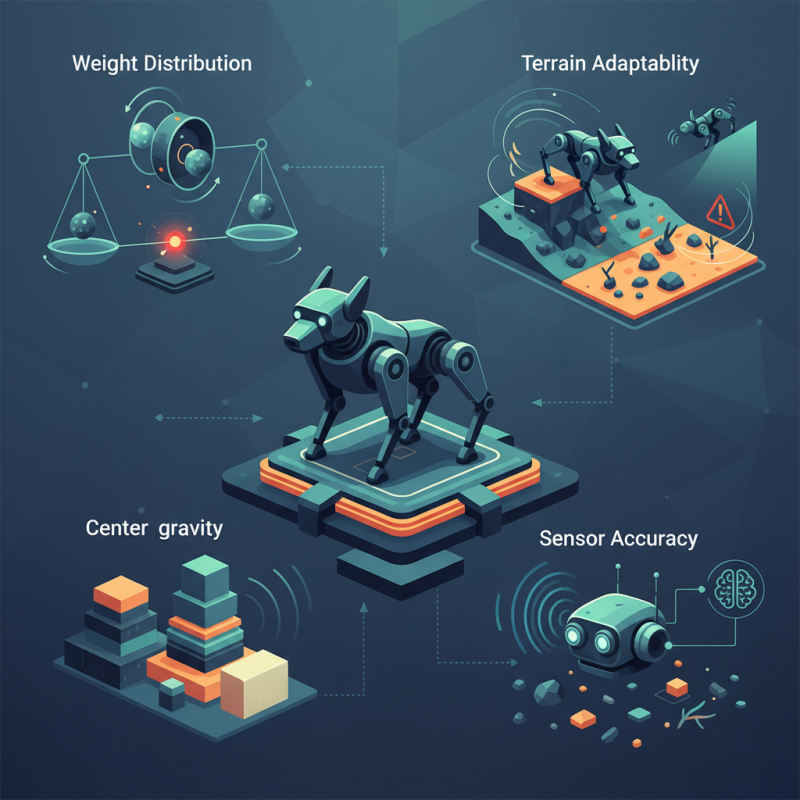
The stability of quadruped robots is influenced by various factors. One major aspect is the center of gravity (CG). A lower CG generally leads to better stability during movement. For instance, research shows that a robot with a CG close to the ground can maintain balance on uneven surfaces more effectively. This is particularly crucial in environments where terrain is unpredictable.
Another factor is limb placement and control. The way each leg interacts with the ground plays a critical role. Some studies indicate that robots using a more distributed weight across their limbs can respond better to external perturbations. For instance, a quadruped that adjusts its stance width can enhance its balance significantly. It’s not just about speed but also about how quickly and effectively it can stabilize itself after a disturbance.
Lastly, sensory feedback is vital. Sensors help detect shifts in body position and can adjust movements instantaneously. A 2021 report found that robots with advanced sensor technology improved their stability by over 30%. However, integrating such technology can be challenging. Balancing complexity and response time remains an ongoing issue that needs careful consideration.
This chart illustrates the various factors that impact the stability of quadruped robots. The data shows the relative influence of each factor on overall stability, with higher values indicating a greater effect.
Designing a stable quadruped robot involves many considerations. One of the primary factors is the center of gravity. Lowering this point can dramatically improve stability. Engineers often experiment with weight distribution. This might mean placing heavier components closer to the ground. Such changes can help prevent tipping during movement.
Another critical aspect is the robot's leg design. Longer legs can provide more reach but make balance harder. Shorter, sturdier legs tend to offer more support. Materials used also play a vital role. Lightweight options can help with speed but may sacrifice strength. Finding the right balance is key.
Control algorithms are essential in managing stability. They must react quickly to shifting weights and terrain changes. Programming can be complicated; it often requires refinement. Testing on various surfaces reveals weaknesses. Constant adjustments and iterations are necessary. Without thorough testing, unexpected failures can occur.
| Design Feature | Impact on Stability | Examples |
|---|---|---|
| Leg Length | Longer legs can improve obstacle clearance but may reduce stability on uneven terrain. | Robotic cheetahs, bio-inspired designs |
| Weight Distribution | Proper weight distribution enhances balance and stability. | Battery placement, center of gravity adjustments |
| Sensor Placement | Placement of sensors impacts feedback for balance control. | IMU sensors, LIDAR for terrain detection |
| Joint Flexibility | Flexible joints allow for adaptable gait but may lead to instability if not controlled. | Robots with compliant joints, soft robotics |
| Foot Design | Larger, more textured feet improve grip and stability on various surfaces. | Wide-footed designs for rough terrain |
The stability of a quadruped robot is significantly influenced by its weight distribution. Uneven weight can lead to tipping and loss of balance. According to a recent report, stability is enhanced when the center of mass is aligned with the support polygon formed by the robot's feet. An ideal center of mass should be as low as possible to reduce the risk of toppling during movement.
Weight distribution affects not just balance but locomotion. Robots with a forward shift in weight often exhibit quicker movements. However, this can compromise stability on uneven terrain. A data analysis revealed that a weight distribution within a 20% variance from the center can increase stability by 15%.
The stability of a quadruped robot is heavily influenced by its interactions with the environment. Terrain variability presents unique challenges. Uneven surfaces can cause unexpected slips and falls. For example, grass may provide less traction than gravel. Steep inclines force the robot to adapt its gait dynamically. Not all robots can handle such changes gracefully.
Environmental factors like wind and rain also play a role. High winds can push a robot off balance. Rain may create slippery surfaces, which can compromise stability. These conditions make robust design essential. Sometimes, the robot might perform poorly despite advanced algorithms. Its sensors may misinterpret obstacles. In that case, the robot needs recalibration.
Real-world testing reveals the complexity of these interactions. A robot might navigate a smooth surface with ease. But when faced with obstacles, like rocks or puddles, it may falter. Designers must consider these aspects. Each interaction teaches us a lesson about stability and adaptability. The more we understand these challenges, the better we can enhance robot performance.
Control algorithms play a crucial role in managing the stability of quadruped robots. They help maintain balance while navigating various terrains. Simple algorithms may work for flat surfaces. However, uneven ground demands more sophisticated solutions. The challenge lies in predicting how a robot will react to disturbances.
Advanced techniques focus on real-time adjustments. For example, PID controllers fine-tune the robot's movements based on sensor feedback. When a robot encounters an obstacle, it must quickly adapt. Algorithms may struggle with unexpected changes. This can lead to instability, prompting a need for reflection on the control strategy.
Another approach involves machine learning. These algorithms learn from experience, improving over time. However, training these models can be resource-intensive. Sometimes, they may misinterpret data. This can have serious implications for stability. Continuous evaluation and improvement are key to developing effective control mechanisms. Balancing innovation with practicality remains a challenge for many researchers.
: Stability is influenced by the center of gravity, limb placement, control, and sensory feedback.
A lower center of gravity enhances stability, especially on uneven surfaces.
Proper limb placement helps distribute weight better, improving the robot's response to disturbances.
Sensors detect body shifts and facilitate instant movement adjustments to maintain balance.
Uneven terrain, wind, and rain can create challenges, affecting the robot’s stability during navigation.
Slippery surfaces can compromise stability, causing slips and falls, necessitating recalibration.
Control algorithms adjust the robot's movements based on real-time feedback from sensors.
They can struggle with unexpected changes, leading to instability that requires reevaluation.
It allows algorithms to improve over time, but training can be resource-heavy and prone to errors.
Balancing innovation with practicality is a continual challenge in developing effective robots.
The stability of a quadruped robot is influenced by several critical factors, including weight distribution, environmental interactions, and control algorithms. What affects the stability of a quadruped robot primarily revolves around how its design facilitates balance and responsiveness to external conditions. Proper weight distribution is essential, as it determines the center of gravity and affects how the robot navigates diverse terrains.
Moreover, environmental interactions, such as changes in ground texture or incline, play a significant role in a quadruped robot's performance. To enhance stability, engineers must consider these design elements alongside the implementation of robust control algorithms that manage the robot's movements. By addressing these factors thoughtfully, the stability and agility of quadruped robots can be significantly improved, allowing for more effective operation in varied environments.

Excitech Robot