Choosing a quadruped robot for research in 2026 requires more than comparing speed, payload, or marketing images. The right platform must match the laboratory’s questions, budget, terrain, and technical capacity. A robot that climbs stairs impressively may still fail during precise manipulation or long outdoor experiments. Why are quadruped robots important for research? They can move through uneven spaces, carry sensors, and collect data where wheeled systems struggle. Their legged design also supports studies in locomotion, perception, autonomy, human–robot interaction, and field robotics.
This guide examines practical selection criteria from a research perspective. It considers actuator performance, battery endurance, payload capacity, sensor integration, software access, simulation tools, and available developer support. A stable application programming interface can save weeks of work. Reliable logging matters just as much. Small failures become expensive when experiments must be repeated.
The floor matters. So does the laboratory team.
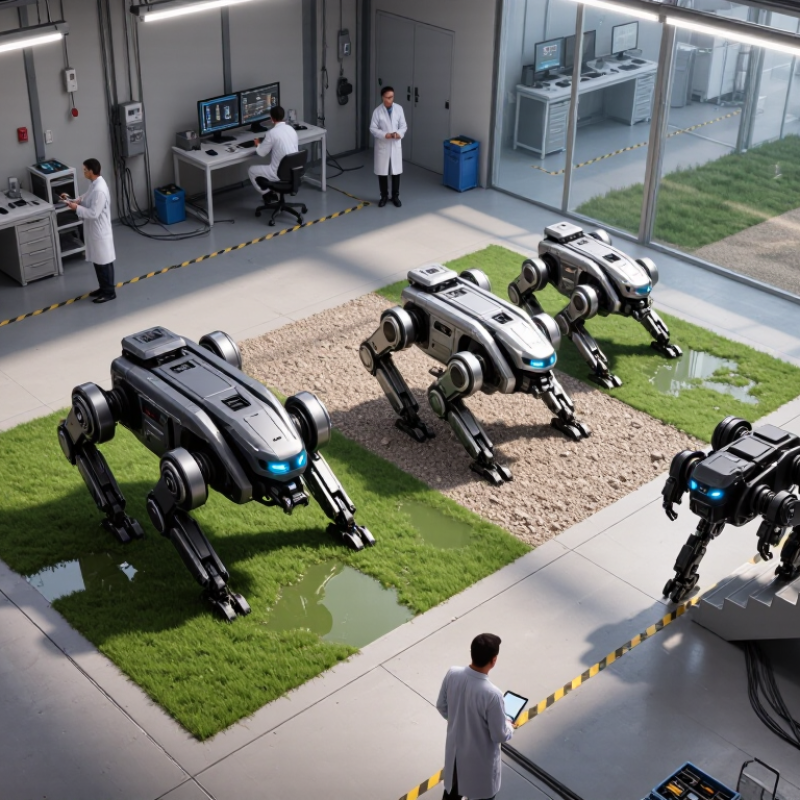
Real-world evaluation should include walking on wet grass, crossing loose gravel, climbing low steps, and recovering from minor contact. Safety controls, emergency stops, speed limits, and responsible testing procedures should remain central. Published specifications offer useful evidence, but independent demonstrations and user reports deserve careful review. No robot is ideal for every project. A capable platform may still demand difficult maintenance, specialist programming, or costly replacement parts. Researchers should document these limitations instead of hiding them. That honesty improves reproducibility and helps institutions make defensible investments.
How to Choose Quadruped Robots for Research in 2026?
Define Research Objectives and Operational Requirements
Research starts with a question, not a robot. Define the experiment in measurable terms. Are you studying locomotion, mapping, manipulation, human interaction, or energy use? A mobility project may require stable walking over gravel, ramps, and loose soil. A perception study may value sensor synchronization and accurate localization more than speed. Write the target conditions before comparing specifications.
Our first checklist was too broad. That mistake made impressive features seem more important than usable data. Set clear metrics, such as walking speed, positioning error, battery duration, payload, and recovery time after a fall. Also consider repeatability. A robot that performs well once but drifts during ten trials can weaken your findings.
Operational requirements often decide the practical choice. Measure doorway widths, stair dimensions, floor surfaces, lighting, noise, and available network access. Check whether researchers can change sensors without redesigning the platform. Confirm access to raw data, software interfaces, logs, and documented update policies. Safety matters too. Use speed limits, emergency stops, supervised testing, and defined exclusion zones. Field trials should begin in a controlled room, then move outdoors gradually. Record failures, not only successful runs. Evidence becomes stronger when limitations are visible. That is uncomfortable, but useful.
A practical, brand-neutral specification matrix for matching research objectives with operational requirements.
| Research objective | Operational environment | Recommended capability band | Important specifications | Acceptance criteria before purchase |
|---|---|---|---|---|
| Locomotion and gait research | Indoor laboratory, motion-capture area, flat test floor | Compact or medium platform; high-level access to joint commands and sensor streams | At least 12 actuated joints, programmable gait frequency, joint position/velocity/torque feedback, synchronized timestamps, emergency stop | Documented SDK, real-time control interface, repeatable walking trials, controllable standing and recovery behaviors |
| Perception and sensor-fusion research | Indoor and outdoor sites with changing lighting, textures, and obstacles | Platform with modular payload mounting and synchronized multi-sensor data | IMU, joint encoders, depth or stereo cameras, optional lidar, hardware time synchronization, accessible raw data | Raw data export, calibration files, sensor time offsets, configurable frame rates, support for common robotics middleware |
| Navigation and autonomy research | Mapped buildings, corridors, ramps, uneven ground, and partially blocked routes | Medium platform with onboard computing and reliable localization interfaces | Odometry access, localization interface, onboard computer expansion, wireless control, obstacle-clearance capability, configurable speed limits | Stable operation during network interruptions, accessible state estimation, repeatable waypoint missions, manual override |
| Manipulation and mobile-manipulator research | Indoor workspaces requiring arm mounting, object interaction, or mobile inspection | Medium or heavy platform with payload margin and mounting provisions | Usable payload commonly about 5–15 kg, payload mounting points, power output, center-of-mass limits, body stabilization | Demonstrated stability with the intended payload, published payload envelope, available power budget, no excessive vibration during manipulation |
| Outdoor terrain and field robotics | Grass, gravel, soil, slopes, shallow steps, and moderate weather exposure | Medium or heavy platform with sealed electronics and higher ground clearance | Typical walking speed of approximately 1–3 m/s, ground clearance around 0.15–0.30 m, slope rating verified by testing, ingress protection stated by the supplier | Terrain trials using the intended surface, recovery after slips, thermal monitoring, weather limitations, field-repair procedure |
| Human–robot interaction research | Shared indoor spaces, laboratories, classrooms, and controlled public demonstrations | Compact or medium platform with low-speed control and clear safety states | Configurable speed below 1 m/s, audible or visual status indicators, physical emergency stop, collision-aware control options | Risk assessment completed, safe stop tested, operator training documented, protective barriers or supervision defined |
| Energy-efficiency and endurance research | Repeated experiments requiring predictable operating time and battery cycling | Platform with replaceable batteries and accessible power telemetry | Typical continuous walking endurance of about 1–3 hours, battery voltage and current reporting, charging time commonly 1–3 hours | Endurance measured with the actual payload, gait, terrain, and sensor load; battery cycle and thermal data available |
| Learning-based control and simulation-to-real transfer | Simulation environment followed by controlled physical experiments | Research-oriented platform with low-level control access and repeatable system identification | High-rate state feedback, configurable control loop, actuator limits available, simulation model or robot description, deterministic logging | Simulation parameters can be identified from real data; control latency, packet loss behavior, and actuator saturation are documented |
| Inspection and data-collection research | Industrial mock-ups, utility corridors, construction areas, or restricted-access facilities | Medium or heavy platform with payload capacity, remote operation, and robust communications | Payload margin of at least 20% above the planned equipment mass, remote monitoring, data storage, lighting or sensor power, communication fallback | Complete route completed without overheating, data integrity verified, communications tested at maximum expected range, recovery plan defined |
| Multi-robot coordination research | Laboratory or outdoor test area with several robots operating simultaneously | Identical or interoperable platforms with centralized and distributed control options | Unique robot identification, synchronized clocks, network diagnostics, independent emergency stops, configurable communication rates | Scalable network test, predictable behavior under packet loss, collision-avoidance procedure, synchronized experiment logs |
Specification note: Capability bands are representative research-planning ranges rather than guarantees for every quadruped platform. Actual speed, endurance, payload, slope performance, weather resistance, control frequency, and sensor availability depend on robot configuration, terrain, payload, software limits, and environmental conditions.
Recommended decision rule: Select the smallest platform that satisfies the required payload, terrain, safety, sensing, and control-access criteria, while reserving at least 20% capacity for future sensors, batteries, or experimental hardware.
How to Choose Quadruped Robots for Research in 2026?
Compare Quadruped Robot Locomotion, Payload, and Mobility
Quadruped locomotion is not just about walking on four legs. For research, test stability across stairs, gravel, wet floors, and narrow platforms. A robot with dynamic trotting may cross uneven ground quickly. However, slower walking often produces cleaner sensor data. That difference matters during experiments.
Payload claims need careful reading. Check whether the rating applies while standing or moving. A useful payload test includes a camera, computer, battery extension, and protective frame. The International Federation of Robotics reported 205,000 professional service robots sold globally in 2023, a 30% annual increase. This wider market figure signals growing adoption, but it does not prove quadruped performance. Treat it as context, not evidence.
Mobility depends on more than leg design. Measure turning radius, stair height, slope angle, recovery after a push, and operating time. IDTechEx’s 2024 legged-robot analysis forecasts a multi-billion-dollar market over the next two decades. Forecasts remain uncertain. Laboratory trials should therefore use repeatable tests, not attractive demonstrations. Record speed under load, battery loss per lap, and failed steps. A small mistake can expose a large weakness. For outdoor research, ingress protection, replaceable joints, and local data logging may matter more than top speed. Some evaluation plans still ignore maintenance time. That is a mistake worth revisiting.
Comparison of representative research-class quadruped specifications by maximum locomotion speed, usable payload, and obstacle-clearing capability.
Compact platforms generally provide lower payload but efficient indoor mobility. Medium platforms offer a balanced choice for laboratory experiments, while heavy-duty and field-oriented platforms are better suited to outdoor sensing, onboard computing, and uneven terrain. Values represent documented capabilities commonly found in research-oriented quadruped platforms and should be verified against the latest technical specification before purchase.
How to Choose Quadruped Robots for Research in 2026?
Evaluate Sensors, Computing, and Software Compatibility
A research quadruped should sense its surroundings reliably, not merely carry many sensors. Check camera frame rates, depth accuracy, inertial measurement quality, and lidar performance under dust or uneven lighting. Sensor timestamps matter. A five-millisecond mismatch can distort mapping during fast turns. Ask for raw data access, calibration tools, and documented interfaces. A datasheet is not enough.
Computing capacity shapes every experiment. Compare processor performance, graphics acceleration, memory, storage, and thermal limits under continuous workloads. A robot that runs smoothly for ten minutes may throttle after an hour. Test onboard inference, simultaneous sensor recording, and motion control together. Measure latency, power use, and recovery after network loss. Small details matter.
Software compatibility often decides whether research progresses or stalls. Confirm support for common middleware, simulation environments, programming languages, and real-time control interfaces. Verify whether developers can change low-level behavior or only use restricted commands. In one trial, an elegant algorithm failed because sensor logs used inconsistent timestamps. That was our mistake. We trusted the demonstration too much. Keep versioned documentation, repeatable test scripts, and recorded datasets. Leave room for imperfect hardware, because field conditions rarely match the laboratory.
How to Choose Quadruped Robots for Research in 2026?
Safety should be tested beside the laboratory bench, not only in a brochure. Check fall detection, emergency stopping, speed limits, and battery temperature monitoring. The ISO 12100 risk-assessment method offers a useful framework, although it was not written specifically for every quadruped platform. Researchers should record stopping distance on wet floors, cables, ramps, and uneven surfaces. Small details matter. A robot that falls safely is more valuable than one that only walks impressively.
Reliability requires evidence from repeated trials. Ask for logged motor faults, joint-temperature limits, battery-cycle results, and mean time between failures. The International Federation of Robotics reported 541,302 industrial robot installations in 2023, showing how quickly robotic systems are entering real workplaces. Quadruped research platforms still face harsher movement demands, so industrial statistics cannot be copied directly. That limitation deserves attention. Request raw test conditions, not polished averages.
Maintenance can decide whether experiments continue after three months. Choose accessible actuators, replaceable foot coverings, standard fasteners, and software logs that export cleanly. Expandability matters equally. Check payload margins, time synchronization, network access, sensor interfaces, and simulation support. NIST’s Cybersecurity Framework 2.0 recommends identifying, protecting, detecting, responding, and recovering from digital risks. Apply those ideas to robot control systems and research data. A cheaper platform may create hidden integration work. I have seen teams underestimate calibration time; the purchase price was not the real cost. Source: IFR, World Robotics 2024; NIST, Cybersecurity Framework 2.0, 2024.
A useful decision starts with the research question, not the robot’s appearance. A low-cost platform may support gait experiments, basic mapping, and classroom demonstrations. In practical lab evaluations, hidden expenses often appear later. Batteries, protective frames, replacement actuators, calibration tools, and integration time can change the real budget. Leave room for mistakes.
Facilities matter as much as funding. Measure door widths, elevator access, floor surfaces, and available testing space before ordering. Hard floors can improve repeatability but increase impact during falls. Stairs need controlled access, safety barriers, and trained operators.
Check whether the robot can run quietly near other experiments. Also review storage conditions, charging requirements, and network reliability.
Research plans should guide the sensor and software choices. For locomotion studies, prioritize stable control, adjustable speed, and accurate joint feedback. For perception research, verify camera mounting space, computing capacity, and time-synchronized data. Human-robot studies need reliable emergency stops and clear operating procedures. Ask about software documentation, interface access, repair support, and spare-part availability. Open interfaces usually reduce long-term dependence on one supplier. However, openness can demand more engineering skill. A platform that seems flexible may consume months of development. I would test a small prototype first, then compare measured performance against the original plan.
Define the experiment first.
Test doorways, stairs, ramps, gravel, loose soil, wet floors, and narrow platforms.
Use repeatable trials across stairs, gravel, slopes, and uneven flooring.
Check whether the payload rating applies during standing, walking, or climbing.
Check emergency stops, fall detection, speed limits, and battery temperature monitoring.
Run repeated trials instead of trusting a single demonstration.
Look for accessible actuators, replaceable foot coverings, standard fasteners, and exportable software logs.
Confirm sensor synchronization, raw-data access, software interfaces, logs, and update documentation.
Create a scorecard for mobility, data quality, safety, reliability, maintenance, and expansion.
Choosing a quadruped robot for research in 2026 begins with a clear understanding of the project’s objectives and operating conditions. Why are quadruped robots important for research? Their ability to move across uneven terrain, handle stairs, and operate in spaces designed for people makes them valuable tools for testing mobility, perception, manipulation, autonomy, and human-robot interaction. Researchers should compare walking stability, speed, obstacle-crossing ability, payload capacity, battery life, and maneuverability according to the intended tasks.
A suitable platform must also provide compatible sensors, onboard computing power, development tools, and software interfaces for experiments and data collection. Safety features, mechanical reliability, maintenance requirements, spare-part access, and the ability to add new hardware are equally important for long-term projects. Finally, researchers should match the robot to their budget, laboratory facilities, technical expertise, and future research plans. The best choice is not necessarily the most advanced system, but the platform that offers a practical balance of performance, flexibility, supportability, and research value.

Excitech Robot