2026 Top Skills Engineers Need for Quadruped Robots?

Time:2026-10-02 Author:Henry
0%

Quadruped robots are moving from controlled demonstrations into inspection, logistics, research, and emergency-response environments. Their four-legged design creates demanding engineering problems. Each foot must manage uneven ground, changing friction, impacts, and unstable body motion. Engineers therefore need more than strong mechanical design skills.

What skills do engineers need for quadruped robots? They need practical knowledge of legged locomotion, embedded systems, control theory, sensor fusion, computer vision, and machine learning. They must understand actuators, gearboxes, batteries, thermal limits, and real-time communication. A robot walking across wet concrete exposes weaknesses that laboratory testing may hide. Field experience matters.

The International Federation of Robotics reported 541,302 industrial robot installations worldwide in 2023. That figure shows a growing automation market, although it does not measure quadruped adoption directly. The IFR’s service-robot research also identifies transportation, inspection, and professional applications as important growth areas. Meanwhile, the World Economic Forum’s Future of Jobs Report 2025 lists analytical thinking, AI, and big data among increasingly valuable skills. These findings support a multidisciplinary engineering approach.

Still, the industry should avoid simple skill checklists. A capable engineer may understand robotics software but lack experience with shock loading or waterproofing. Another may build excellent hardware but underestimate data quality. That gap is real. In 2026, successful quadruped engineers will combine simulation with repeated field testing, safety awareness, documentation, and honest failure analysis. Reliability will matter more than impressive walking videos.
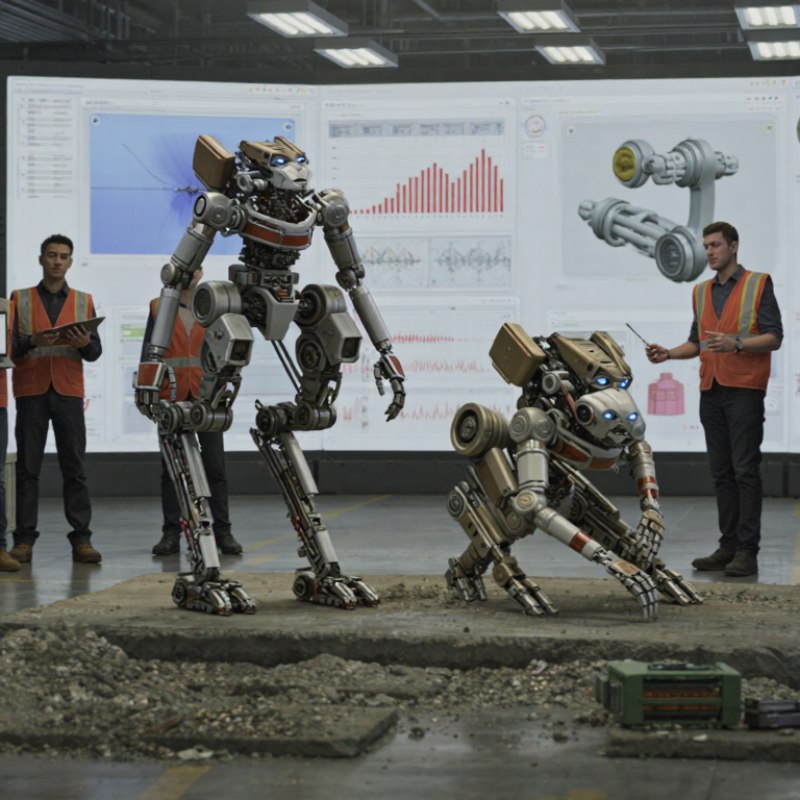
2026 Top Skills Engineers Need for Quadruped Robots?

Quadruped Robot Architecture and Locomotion Fundamentals

2026 Top Skills Engineers Need for Quadruped Robots

Quadruped robot architecture begins with clear links between mechanical hardware, sensing, power, and control software. The body needs lightweight strength, stable joints, protected wiring, and efficient thermal management. Each leg usually includes actuators, position encoders, and contact sensing. An onboard computer combines these signals with inertial measurements. Good architecture also separates fast motor control from slower planning tasks. This separation improves safety and makes testing easier. Still, real hardware often disagrees with neat diagrams.

Locomotion fundamentals depend on state estimation, gait planning, and feedback control. Engineers must understand stance phases, swing phases, foot placement, and ground reaction forces. A trot can move quickly, but uneven ground exposes weak assumptions. The controller should estimate body motion while detecting slips and unexpected contacts. Simulation helps, yet simulated friction rarely matches wet concrete or loose soil. That gap requires careful experiments, repeatable measurements, and honest failure analysis. Sometimes, a simpler gait works better.

Tips: Start with a reliable standing controller before attempting dynamic walking. Log joint temperature, motor current, body attitude, and foot contacts during every test. Use slow motion to inspect foot trajectories. Tune one variable at a time. Keep safety limits active, even in controlled environments. Engineers should also study embedded systems, numerical methods, mechanical design, and robotic control together. No single skill is enough.

Mechanical Design for Stability, Agility, and Terrain Adaptation

2026 Top Skills Engineers Need for Quadruped Robots

Mechanical design now determines whether a quadruped robot walks confidently or stumbles. Engineers must balance body mass, joint torque, battery placement, and structural stiffness. A low center of gravity improves stability, but excessive weight reduces agility. Every gram matters.

Terrain adaptation requires more than powerful actuators. Engineers should design compliant feet, sealed joints, and replaceable contact surfaces. They must test gravel, wet slopes, loose soil, and narrow steps. Useful measurements include slip ratio, body roll, energy per meter, and recovery time. Field experience often exposes problems that simulations miss. Real stones are less polite.

The International Federation of Robotics reported nearly 205,000 professional service robots sold in 2023, a 30% annual increase in its World Robotics 2024 report. This growth suggests stronger demand for mobile machines, including difficult-terrain platforms. However, industry-wide figures do not measure quadruped capability directly. That limitation deserves attention. Engineers should combine report data with repeatable terrain trials and failure logs. A successful design may still need better thermal management, simpler maintenance access, or stronger protection around exposed linkages. Reliability is not an afterthought. It is mechanical design in practice.

Control Systems, Gait Planning, and Real-Time Motion Coordination

2026 Top Skills Engineers Need for Quadruped Robots

In 2026, quadruped engineers need more than fast motors and polished simulations. They need control systems that remain calm when sensors disagree. A practical controller combines state estimation, torque limits, contact detection, and fault handling. Each leg should react to ground pressure, not merely follow a clock. A loose stone can shift the body within milliseconds. The estimator must notice that change and adjust posture before the next foothold. Timing matters.

Gait planning then turns stability into movement. Engineers compare walk, trot, and bound patterns using terrain slope, speed, energy use, and recovery margin. A gait that looks elegant on a flat floor may fail beside a curb. Test the ugly cases.

Real-time motion coordination connects these layers.

The planner requests a foothold, the controller checks available force, and the body manager shares corrections across all four legs. This loop must run predictably, even when computation rises. In field testing, logging joint targets, contact events, and foot slip reveals errors that video can hide.

My early designs reacted too aggressively to one bad contact reading. The robot corrected itself, then created a larger sway. Filtering helped, but it also added delay. That tradeoff needs measurement, not optimism.

Engineers should replay failures, vary payloads, and test emergency stops on safe indoor surfaces. Clear limits matter. Reliable systems come from repeatable experiments, careful calibration, and honest review of assumptions. A small timing error can become a large stumble.

Perception, Sensor Fusion, and Autonomous Environmental Understanding

Quadruped robots in 2026 will need perception skills that work beyond clean laboratory floors. Engineers must understand cameras, depth sensors, radar, and inertial measurements. Each sensor fails differently. Dust can soften images, while wet stones may confuse depth readings. Field tests often expose problems that simulation hides.

Sensor fusion turns separate measurements into a usable scene. Engineers should study calibration, time synchronization, coordinate frames, and uncertainty estimation. A robot may detect a step, but still misjudge its height. That happened when vibration shifted a sensor mount during testing. The system remained operational, yet its confidence estimate was too optimistic. Better logging and fault detection could have revealed the drift earlier.

Autonomous environmental understanding requires more than obstacle detection. The robot should identify traversable ground, unstable surfaces, slopes, narrow gaps, and changing objects. It must connect perception with movement decisions at low latency. Clear data pipelines matter. So do disciplined field notes. Engineers should question every successful trial, because success can depend on lighting, weather, or a lucky foothold. A useful system explains what it sees, what it cannot see, and when human review is needed. That last capability is often neglected.

Safety Engineering, Human Collaboration, and Responsible Deployment

2026 Top Skills Engineers Need for Quadruped Robots?

Safety engineering must become a daily practice, not a final inspection. Engineers need to map hazards around stairs, wet floors, loose cables, and moving people. A robot can lose balance in seconds. Its software should detect unsafe conditions, slow down, and stop safely. Physical tests matter too. Simulated success is not enough. Field logs should record near misses, unexpected contacts, and confusing sensor readings. Small failures reveal larger design weaknesses.

Human collaboration requires more than friendly interfaces. Operators need clear alerts, simple controls, and honest information about uncertainty. A worker should know when the robot is guessing. Engineers must observe people using the system under pressure. In one trial, an alarm was technically correct but too quiet near machinery. The team improved it, yet the delay exposed a missed assumption. Listening is an engineering skill.

Responsible deployment also demands restraint. Engineers should define where the robot belongs, who supervises it, and when use must stop. Privacy protection, maintenance records, and access controls need attention from the beginning. Training should include technicians, nearby workers, and emergency personnel. Not every impressive demonstration justifies deployment. A cautious rollout may feel slow. It can prevent expensive harm and protect public trust. The hardest decision may be saying not yet.

FAQS

What are the main parts of a quadruped robot architecture?

The architecture links mechanical hardware, sensors, power systems, and control software. Each leg usually contains actuators, encoders, and contact sensors. Protected wiring and thermal management matter. Neat diagrams often fail on real hardware.

Why should engineers separate motor control from motion planning?

Fast motor control handles immediate stability and safety. Slower planning manages routes, gaits, and foot placement. This separation simplifies testing. It also limits dangerous delays.

What should a robot controller understand before dynamic walking?

It should estimate body motion, stance phases, swing phases, and ground forces. Start with stable standing. Then test slow steps. Dynamic walking can wait.

Which measurements are useful during walking tests?

Record joint temperature, motor current, body attitude, and foot contacts. Measure slip ratio, body roll, energy per meter, and recovery time. Use slow-motion video to inspect foot paths. One variable at a time works better.

How can mechanical design improve stability and agility?

Engineers must balance body mass, joint torque, battery placement, and structural stiffness. A low center of gravity improves stability. Excessive weight reduces agility. Every gram matters.

What features help a quadruped handle difficult terrain?

Compliant feet, sealed joints, and replaceable contact surfaces improve terrain adaptation. Test gravel, wet slopes, loose soil, and narrow steps. Real stones behave unpredictably. Powerful actuators alone are insufficient.

Why does simulation fail to predict every walking problem?

Simulated friction rarely matches wet concrete, loose soil, or irregular stones. Field testing reveals slips and unexpected contacts. Repeatable trials and failure logs expose weak assumptions. A simpler gait may perform better.

How should robots combine different sensor readings?

Sensor fusion combines cameras, depth sensors, radar, and inertial measurements. Engineers need calibration, time synchronization, coordinate frames, and uncertainty estimates. Vibration can shift a sensor mount. Confidence may become too optimistic.

What should autonomous environmental understanding include?

The robot should recognize traversable ground, unstable surfaces, slopes, narrow gaps, and moving objects. It must connect perception with movement decisions quickly. It should also report uncertainty. Human review may still be necessary.

Which skills do engineers need for reliable quadruped robots?

They need embedded systems, numerical methods, mechanical design, perception, and robotic control. No single skill is enough. Engineers should question successful tests too. Good lighting or a lucky foothold can hide a weakness.

Conclusion

What skills do engineers need for quadruped robots? In 2026, successful development will require a multidisciplinary understanding of quadruped robot architecture, including actuators, power systems, embedded computing, and the software layers that connect them. Engineers must also be able to design lightweight yet durable mechanical structures that maintain stability, support agile movement, and adapt to uneven terrain, slopes, and changing loads. A strong foundation in control theory will be essential for gait planning, balance recovery, trajectory generation, and real-time coordination among multiple legs.

Beyond movement, engineers will need expertise in perception, sensor fusion, and autonomous environmental understanding. Combining data from cameras, depth sensors, inertial units, and contact sensors can help robots interpret surroundings and respond reliably. Equally important are safety engineering, human-robot collaboration, testing, and responsible deployment. Engineers should design systems with predictable behavior, secure operation, clear limitations, and effective emergency responses, ensuring quadruped robots can assist people while operating responsibly in complex environments.

Henry

Henry

Henry is a dedicated marketing professional with a profound expertise in the company's offerings. With years of experience in the industry, he possesses an impressive understanding of the market dynamics and consumer behaviors that drive success. Henry is committed to sharing his insights through......